S·01 · The engine
The Sun, in cross-section
Everything on this site runs on one machine: a ball of plasma 109 Earths wide, converting four million tonnes of matter into light every second. It is so ordinary that astronomers file it as a G-type main-sequence star, and so important that a separate science — heliophysics — exists just to watch it. Hover the layers.
Light's long walk
A photon born in the core does not fly out — it staggers. In the radiative zone it is absorbed and re-emitted so relentlessly that the energy takes on the order of a hundred thousand years to random-walk its way to the surface. The light warming you today is, in that sense, prehistoric: made before agriculture, delivered this morning, plus an eight-minute sprint across space at the end.
The corona problem
Here is an unsolved mystery you can see with your own eyes during an eclipse: the Sun's surface is about 5,500 °C, but the wispy corona above it runs at millions of degrees. Heat should not flow from cool to hot — something else carries energy up, likely a mix of magnetic wave heating and countless "nanoflares." Solving it is a headline goal of the mission in the next section, which is why we built a spacecraft to fly into it.
S·02 · The heartbeat
An eleven-year pulse
The Sun keeps time. Roughly every eleven years its magnetic field winds up, erupts into a rash of sunspots and flares, then flips polarity entirely and quiets down. Humans have counted the spots since Galileo; the numbered record runs back to 1755.
Sunspots are bruises where the magnetic field punches through the surface and blocks convection — cooler, so darker, though a sunspot alone would still glow brighter than the full Moon. Their count is the Sun's mood ring: solar maximum brings auroras at absurd latitudes and radio blackouts; minimum brings calm and lets more galactic cosmic rays into the solar system. The current cycle — number 25 — peaked stronger than forecast, a reminder that we can count the heartbeat far better than we can predict it.

A sunspot group the size of several Earths, mid-eruption. NASA/SDO
S·03 · When it reaches us
Space weather
The Sun does not stay in its lane. It exhales a constant solar wind, and occasionally it throws billions of tonnes of magnetized plasma — a coronal mass ejection — straight down our orbit.
The benchmark is the Carrington Event of 1859: a CME so strong that auroras were seen in the Caribbean and telegraph lines sparked, shocked their operators, and in places kept working with their batteries disconnected — powered by the sky. Run the same storm into today's civilization and the exposure is transformers, GPS, aviation routes, and satellite fleets; a 2012 CME of comparable scale crossed Earth's orbit and missed us by about nine days. This is why space weather is a forecasting discipline now, with its own watches and warnings — and why planetary defense thinking doesn't stop at asteroids →
The upside of the same physics is the aurora: solar particles funneled down the magnetic poles, making the sky itself fluoresce. Cycle 25's maximum pushed the lights into skies that had not seen them in generations — no telescope required →

A flare in extreme ultraviolet — SDO watches the Sun in wavelengths our eyes were never issued. NASA/GSFC
S·04 · Touching it
The spacecraft that flew into the Sun
In 2021, Parker Solar Probe crossed into the corona — the first spacecraft to fly through a star's atmosphere — and by its closest passes it was moving faster than any human-made object in history, brushing the Sun from about six million kilometers out behind a shield that faces a furnace so its instruments can sit at room temperature.
Parker exists to answer two old questions: why the corona is impossibly hot, and what launches the solar wind. Together with ESA's Solar Orbiter — which is climbing out of the ecliptic to photograph the Sun's poles for the first time — and the stethoscope science of helioseismology (reading the Sun's interior from the way sound waves make its whole surface ring), the Sun has become the one star we can study up close. Every other star on this site is calibrated against it. What the Sun's siblings get up to →
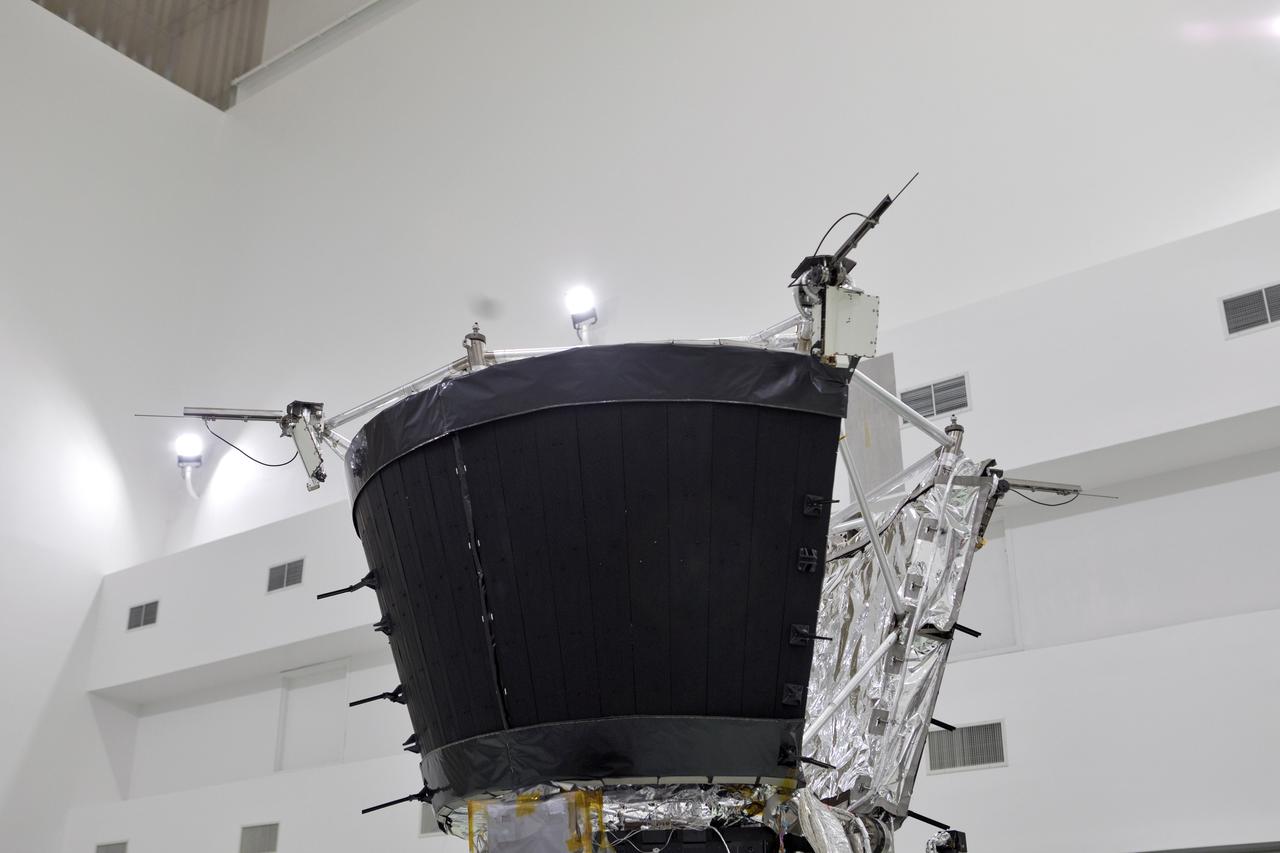
Parker Solar Probe in the cleanroom — the heat shield is the white disc it hides behind. NASA/KSC

The corona, revealed — 2017 total eclipse. The only time the Sun's atmosphere is visible to the naked eye. NASA/AFRC