W·01 · Follow the water
The oceans are out there
For a century, "habitable" meant one thing: the right distance from the Sun for liquid water. Then spacecraft reached the outer solar system and found the largest oceans we know of — under miles of ice, on moons that should be frozen solid. The habitable zone, it turns out, has a basement.
The heat source is not sunlight but gravity itself. A moon on a slightly eccentric orbit is closer to its giant planet at some points than others, so the tidal bulge raised in its body rises and falls every orbit — the moon is kneaded like dough, and friction turns the kneading into heat. Orbital resonances with sibling moons keep the eccentricity from damping away, so the oven never switches off. The animation shows the mechanism: watch the flexing peak at closest approach.
The census so far: Europa and Enceladus almost certainly hide salty liquid oceans in contact with rock — the configuration chemistry likes. Ganymede and Callisto likely hold deeper, ice-sandwiched oceans; Titan has one beneath its surface in addition to the methane lakes on top; and even distant Triton and Pluto show hints. Count them up and the solar system may hold ten times more liquid water off Earth than on it.
W·02 · The favorite
Europa — more water than Earth
Jupiter's fourth-largest moon is an ice-wrapped water world: beneath a frozen shell lies an ocean estimated to hold roughly twice the liquid water of all Earth's oceans combined. Hover the layers.
The surface gives the ocean away. Europa is crisscrossed by cracks stained with salts from below, and patches of "chaos terrain" where the shell has broken into rafts, drifted, and refrozen — sea ice behavior, planetary scale. The ocean floor touches rock, which matters enormously: water-rock chemistry is how Earth's seafloor vents brew the ingredients of life without any sunlight at all.
Europa Clipper — the largest planetary spacecraft NASA has ever built — launched in October 2024 and arrives in 2030 to run dozens of close flybys: ice-penetrating radar to measure the shell, spectrometers to taste the surface salts, and instruments ready in case Europa's suspected water plumes put the ocean within direct reach. It is not a life-detection mission; it is the habitability survey that decides whether the next mission should be. Why that word choice matters →
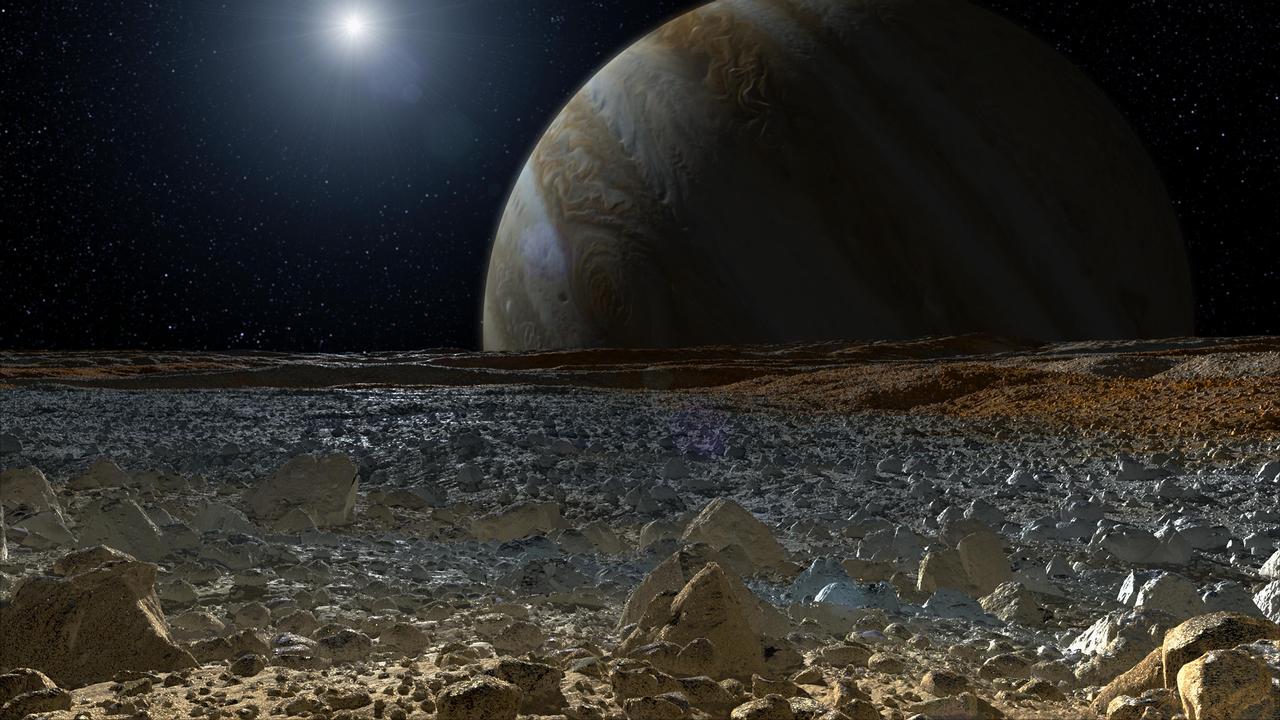
Standing on Europa — Jupiter fills the sky, the ocean waits below. NASA/JPL-Caltech
W·03 · The one that leaks
Enceladus — the ocean you can fly through
Saturn's small moon Enceladus solved the hardest problem in ocean-world exploration — how to sample a sea under kilometers of ice — by doing it for us. Its south pole jets the ocean into space.
In 2005 the Cassini spacecraft found geysers erupting from four great fissures — the "tiger stripes" — near the moon's south pole. Over the following decade Cassini flew directly through the plumes, closest pass under 50 km, and its instruments read the ocean's ingredients on the wing: salt water, organic molecules, silica grains that argue for hot water-rock chemistry at the seafloor, molecular hydrogen — food, in the currency of Earth's deep-sea microbes — and, in later analyses of the data, phosphates. Every box on the standard habitability checklist, ticked by a moon 500 km across.
The plume snow falls back and also escapes to feed Saturn's E ring — meaning Enceladus's ocean is, right now, gently salting the Saturn system. A future mission could sample it with nothing more exotic than a slow flyby and a clean collector. In the search for life beyond Earth, Enceladus is the lowest door.

Enceladus, backlit — the plumes are the bright spray at the south pole. NASA/JPL/SSI
W·04 · The alternative chemistry set
Titan — rain, rivers, and a second recipe
Saturn's largest moon is the only world besides Earth with standing liquid on its surface and weather to refill it — except the working fluid is methane, at −179 °C, under an atmosphere thicker than ours.
Titan runs a complete hydrologic cycle with hydrocarbons: methane clouds, methane rain carving river networks, and polar seas — Ligeia Mare, Kraken Mare — hundreds of kilometers across. The orange haze that hides it all is a photochemical smog factory raining complex organics onto the surface, making Titan a planet-sized experiment in prebiotic chemistry. And beneath the crust, gravity data says there is also a conventional water ocean — two solvent systems stacked on one moon.
The Huygens probe parachuted through the haze in January 2005 — still the most distant landing ever made — and photographed river-cut hills and a floodplain of ice pebbles. Next comes Dragonfly: a car-sized nuclear rotorcraft that will fly from site to site across Titan's dunes, sampling the organics. In Titan's thick air and low gravity, flying is easier than driving — Ingenuity's 72 flights → were the rehearsal.

Titan from Huygens during descent — river channels on an alien world. ESA/NASA/JPL/UA

Titan's dune seas by Cassini radar — Dragonfly's future commute. NASA/JPL
W·05 · The rest of the basement
The wider census
The ocean-worlds club keeps admitting members.
| World | The evidence | Next visitor |
|---|---|---|
| Ganymede | Largest moon in the solar system; its own magnetic field, aurorae betraying a deep salty ocean | ESA's JUICE — arriving 2031, settling into Ganymede orbit in the mid-2030s |
| Callisto | Induced magnetic signature suggests a buried ocean under an ancient, battered crust | JUICE flybys |
| Triton | Neptune's captured moon; Voyager 2 saw active geysers and a young surface in 1989 | None funded — the loudest gap in the program |
| Pluto | New Horizons' data on the Sputnik Planitia basin fits a sluggish subsurface ocean | None planned |
| Ceres | Bright carbonate deposits in Occator crater — brine reaching the surface of an asteroid-belt dwarf | Held for the small-worlds wave of this atlas |
The pattern across the whole table: where there is ice, tides, and time, water finds a way to stay liquid. Which reframes the oldest question on the life page → — the nearest habitable environments may not be light-years away. They may be a rocket ride. About that →