Distance from Sun
Light travel time
Year length
Known moons
01 · The neighborhood
Eight planets orbiting in real proportion — one Earth year passes every ten seconds. Orbits are spaced on a log scale so Mercury and Neptune fit in one frame. Click any planet.
Values from the NASA NSSDCA Planetary Fact Sheet — U.S. government data, public domain. Click a column to rank the planets by it.
| Planet | Mass (10²⁴ kg) |
Diameter (km) |
Density (kg/m³) |
Gravity (m/s²) |
Escape v (km/s) |
Day length (hours) |
Sun distance (10⁶ km) |
Orbit (days) |
Mean temp (°C) |
Moons |
|---|---|---|---|---|---|---|---|---|---|---|
| Mercury | 0.330 | 4,879 | 5,429 | 3.7 | 4.3 | 4,222.6 | 57.9 | 88.0 | 167 | 0 |
| Venus | 4.87 | 12,104 | 5,243 | 8.9 | 10.4 | 2,802.0 | 108.2 | 224.7 | 464 | 0 |
| Earth | 5.97 | 12,756 | 5,514 | 9.8 | 11.2 | 24.0 | 149.6 | 365.2 | 15 | 1 |
| Mars | 0.642 | 6,792 | 3,934 | 3.7 | 5.0 | 24.7 | 228.0 | 687.0 | −65 | 2 |
| Jupiter | 1,898 | 142,984 | 1,326 | 23.1 | 59.5 | 9.9 | 778.5 | 4,331 | −110 | 95 |
| Saturn | 568 | 120,536 | 687 | 9.0 | 35.5 | 10.7 | 1,432.0 | 10,747 | −140 | 274 |
| Uranus | 86.8 | 51,118 | 1,270 | 8.7 | 21.3 | 17.2 | 2,867.0 | 30,589 | −195 | 28 |
| Neptune | 102 | 49,528 | 1,638 | 11.0 | 23.5 | 16.1 | 4,515.0 | 59,800 | −200 | 16 |
Day lengths are the solar day; Saturn's density of 687 kg/m³ means it would float, if you could find the bathtub. Moon counts move as surveys find more — Saturn jumped past Jupiter in 2023.
09 · The Moon
The only other world humans have stood on — and the best-measured object in the sky. The panel below is computed live in your browser from orbital mathematics; no server involved.
Fraction of the disc lit as seen from Earth, from the current phase angle.
First-order estimate from the Moon's elliptical orbit — good to a fraction of a percent. Mean distance: 384,400 km.
Computed from the 29.53-day synodic cycle. Check any almanac against this — it should agree to within hours.
The leading, sample-backed account: about 4.5 billion years ago a Mars-sized body — named Theia — struck the young Earth, and the Moon condensed from the debris. Apollo rocks share Earth's oxygen-isotope fingerprint, which is why this theory won.
Laser pulses bounced off retroreflectors left by Apollo crews measure the distance to millimeters. Verdict: the Moon spirals outward about 3.8 cm per year, stealing angular momentum from Earth and lengthening our days.
Tidal forces locked its rotation to its orbit long ago. But it wobbles — librations let patient observers glimpse about 59% of the surface over time. No one saw the far side until a spacecraft flew around in 1959.
The near side is painted with dark volcanic plains — the maria. The far side is almost all bright, battered highlands with a thicker crust. Why the asymmetry exists is still an open research question.
Inside polar craters that never see sunlight, temperatures stay cold enough to trap ice for billions of years. NASA's LCROSS impact confirmed water there in 2009 — the resource anchoring plans to return, this time to the south pole.
Seismometers deployed by Apollo crews recorded moonquakes for years: deep quakes flexed by Earth's tides, thermal cracking at sunrise, and rare shallow quakes strong enough to matter for future bases.
Only a whisper-thin exosphere. With no blanket, the equator swings from roughly −170 °C at night to over 100 °C in daylight — one reason Apollo missions landed at lunar morning.
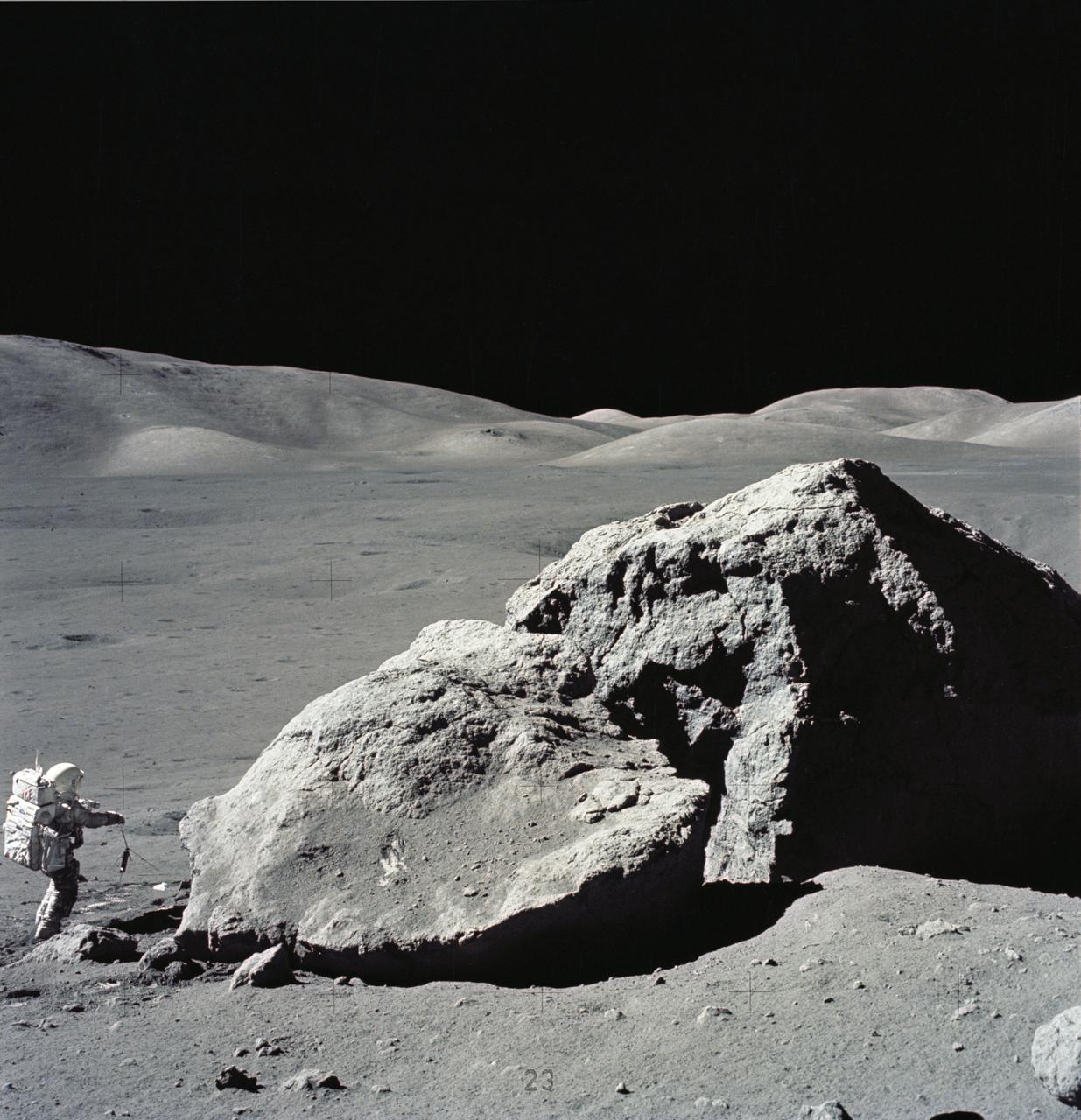
Between 1969 and 1972, twelve humans walked its surface and carried home 382 kg of rock and soil — samples still being opened and studied with instruments that didn't exist when they were collected.


15 · Solar weather
Two kinds of eruption matter to us. A solar flare is a flash of radiation that reaches Earth in 8 minutes. A coronal mass ejection (CME) is a billion-ton cloud of magnetized plasma that takes one to three days to arrive — and when it hits, it squeezes Earth's magnetic field, paints the sky with aurora, and can push currents through power grids. The live Kp dial at the top of this page and the aurora panel on the observatory wall are this section's instruments.
The strongest geomagnetic storm on record. Aurora were reported near the tropics, and telegraph lines sparked — some operators sent messages on the storm's induced current alone. The benchmark for what the Sun can do to a wired civilization.
A CME-driven storm collapsed the Hydro-Québec power grid in about 90 seconds, leaving millions without electricity for nine hours — the event that made space weather an engineering discipline.
16 · The far suburbs
The planets are not where the solar system ends. Beyond Neptune lie two vast reservoirs of leftover construction material — one we have photographed, and one so far away we have only ever seen its messengers. The strip below is drawn to a logarithmic scale; on a linear one, everything you've met on this page so far would fit inside the first pixel.
Logarithmic scale · 1 AU = the Earth–Sun distance · drawn by this page from the distances themselves
A doughnut of icy bodies from about 30 to 55 AU, holding Pluto, Eris, Makemake, Haumea, and hundreds of thousands of smaller worlds — the source of short-period comets. New Horizons crossed it and in 2019 photographed Arrokoth, a gently fused two-lobed body 6.6 billion km out: the most distant world ever visited.
It is still being mapped: in its first year and a half of test data, the Rubin Observatory added roughly 380 new trans-Neptunian objects, including two on orbits stretching about a thousand AU from the Sun.
Honesty first: no one has ever observed the Oort Cloud directly. Its existence is deduced from the long-period comets that fall in from every direction of the sky, pointing back to a spherical shell of trillions of icy bodies roughly 2,000 to 100,000 AU out — the true gravitational edge of the Sun's domain, reaching a substantial fraction of the way to the next star.
Its scale defeats even our fastest machines: Voyager 1, doing 17 km/s for five decades, would need about 300 more years to reach its inner edge — and tens of thousands to pass through. When comet Hale-Bopp lit up the sky in 1997, you were looking at an Oort Cloud resident on a rare visit downtown.


17 · Near-Earth objects
More than 40,000 near-Earth asteroids are now catalogued, and the system that watches them is genuinely global: survey telescopes feed every sighting to the IAU's Minor Planet Center — the world's clearinghouse — while NASA's CNEOS and ESA's NEO Coordination Centre independently compute each orbit a century ahead. Two UN-endorsed bodies, IAWN and SMPAG, exist to coordinate warning and response between nations. And in 2022 the theory got its first field test: NASA's DART spacecraft rammed the moonlet Dimorphos and shortened its orbit by about half an hour — the first time humanity deliberately moved a celestial body. ESA's Hera probe is on its way there now to inspect the crater.
| Object | Closest approach | Miss distance | Speed |
|---|---|---|---|
| 2026 PB9 | 2026-Aug-20 | 4.4 lunar distances | 11.0 km/s |
| 2026 PX | 2026-Aug-23 | 2.4 lunar distances | 6.8 km/s |
| 2024 RV12 | 2026-Sep-09 | 5.6 lunar distances | 12.1 km/s |
| 2018 SP2 | 2026-Sep-30 | 5.0 lunar distances | 14.3 km/s |
| 2015 TS238 | 2026-Oct-08 | 4.7 lunar distances | 15.8 km/s |
| 2022 UP6 | 2026-Oct-15 | 2.6 lunar distances | 9.0 km/s |
Upcoming close approaches within 10 lunar distances — snapshot queried from the NASA/JPL CNEOS close-approach database on August 19, 2026. None poses a threat; passes like these happen constantly. Live table at CNEOS below.


| Passing Earth today | Size (est.) | Miss distance | Speed |
|---|---|---|---|
| querying NASA NeoWs… | |||
Fetching today's tracked close approaches…