06 · The observatory
Hubble — the eye that stayed open
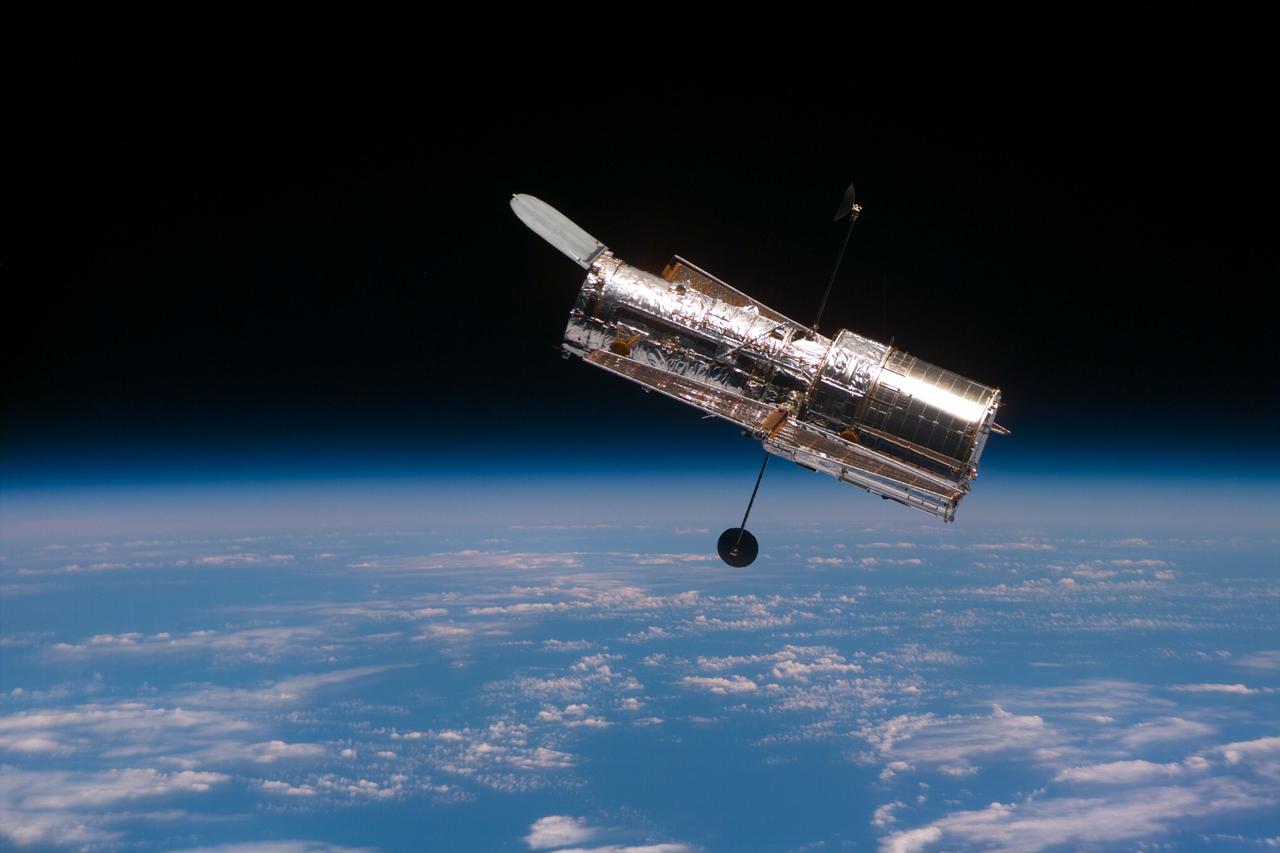
Carried to orbit aboard Space Shuttle Discovery on April 24, 1990, the Hubble Space Telescope has circled Earth above the blurring atmosphere ever since. Five shuttle servicing missions repaired its famously flawed mirror and upgraded its instruments — making it the only telescope ever maintained by astronauts in space. Its observations underpin the measurement of the universe's expansion rate and the deep fields on this page.
Explore its output directly: ESA/Hubble image archive · raw data at MAST · its successor, Webb
08 · The new eye
Rubin — the camera that outgrew astronomy
On Cerro Pachón in the Chilean Andes, the NSF–DOE Vera C. Rubin Observatory released its first images on June 23, 2025, after roughly 25 years of research and construction. It is named for Vera Rubin, the astronomer whose galaxy-rotation measurements gave us conclusive evidence of dark matter — which the observatory is built to hunt.
The glass and the sensor
The Simonyi Survey Telescope uses an unusual three-mirror design: an 8.4-meter mirror whose primary and tertiary surfaces are ground into a single piece of glass, paired with a 3.5-meter secondary. At its heart sits the LSST Camera — the largest digital camera ever built. It is the size of a small car, weighs over 3,000 kg, and its focal plane packs 189 separate CCD sensors of 16 megapixels each — 3,200 megapixels per exposure, cycling through six color filters (u, g, r, i, z, y). Its resolution would show a golf ball 25 kilometers away. One exposure covers about 45 full moons' worth of sky.
The data problem
A new 3,200-megapixel image lands roughly every 40 seconds, all night, for ten years — about 20 terabytes per night, photographing the entire southern sky every three to four nights. By the end of the decade-long Legacy Survey of Space and Time, processed data is expected to reach around 500 petabytes. No human can look at this. The images stream over dedicated fiber to the U.S. Data Facility at SLAC, where software compares each frame to the last and fires off an alert for everything that moved or changed brightness — millions of alerts every night, triaged by automated "broker" systems that decide what deserves a follow-up telescope. Rubin is less a camera than a ten-year film of the universe, with computers as its first audience.
■ your 4K TV · the whole grid: one single Rubin exposure at full size — about 400 4K screens
See its images (CC BY 4.0) and survey progress at the official Rubin Observatory site and NOIRLab program page.


10 · The observatory wall
The newest frames on Earth
These are not archive photos. Each panel below hotloads the most recent image the instrument has published — typically minutes old — and refreshes itself every five minutes while you're here. All are U.S. government feeds in the public domain.
If a panel is dark, the instrument may be between frames — it heals on the next refresh.

Astronomy Picture of the Day
Fetching today's pick from NASA's longest-running website — an astronomer-curated image every single day since 1995.
12 · The instruments, in the round
Webb & Hubble — engineering models
Two interactive schematic models built from published engineering facts and public spacecraft photographs. Drag to turn, scroll or use the + / − buttons to zoom right in on the mirror segments, and flip on schematic mode to see the structure as a wireframe blueprint. Webb loads first: all 18 gold hexagons, the tripod-mounted secondary, the five-layer sunshield, and the momentum flap that balances the pressure of sunlight itself.
24 · The people
The ones who looked
This page is full of machines. Every one of them exists because a person noticed something and refused to let it go — several of them while being paid little, doubted much, or passed over for the prize.

Henrietta Leavitt
Hired as a "computer" to measure star brightnesses for 30 cents an hour, she noticed that Cepheid stars' pulse period reveals their true luminosity — turning them into distance markers. Every cosmic distance on this page, and Hubble's discovery of other galaxies, stands on her ruler.

Cecilia Payne-Gaposchkin
Her 1925 doctoral thesis showed stars are made mostly of hydrogen — contradicting the era's consensus so hard that a senior astronomer persuaded her to soften the claim. She was right. It's been called the most brilliant astronomy PhD thesis ever written.

Vera Rubin
Measuring how galaxies spin, she and Kent Ford found the edges rotating far too fast for the visible matter to hold them — the clinching evidence for dark matter. Section 8's observatory, now photographing the sky she weighed, carries her name.

Jocelyn Bell Burnell
As a graduate student in 1967 she spotted a pulse repeating every 1.3 seconds in her radio data — jokingly tagged LGM-1, "little green men." It was the first pulsar. The 1974 Nobel went to her supervisor; in 2018 she won a $3M Breakthrough Prize and gave it all away to fund underrepresented physics students.
Carl Sagan
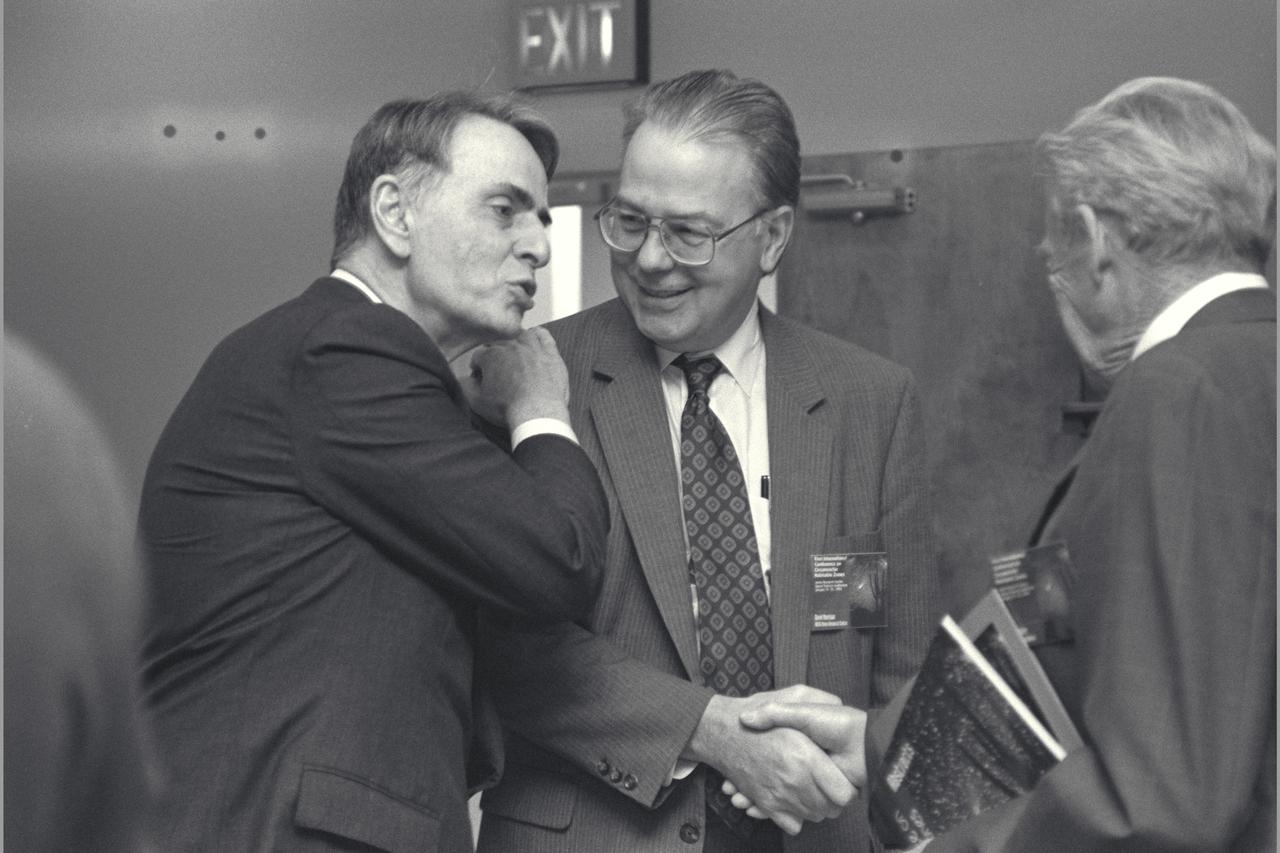
Scientist on Viking, Voyager and more — and the century's great translator of the sky. In 1990 he convinced NASA to turn Voyager 1's camera back toward home from 6 billion km out. The photo, one pale pixel, is in section 7. This frame: Sagan at NASA Ames in 1994, at the first conference on habitable zones — the field section 23 grew into.
A pattern worth naming. Three of the five discoveries above were made by women who were underpaid, under-credited, or both, working with catalogs and patience rather than the biggest telescopes. The lesson for the next discovery is that it may already be sitting in someone's data, waiting for the person stubborn enough to notice.