22 · Exoplanets
Planets of other suns
In 1994 the confirmed count of planets around Sun-like stars was zero. The counter below asks the NASA Exoplanet Archive for today's number.
confirmed planets · NASA Exoplanet Archive · checking live…
The transit wink
Watch a star long enough and a planet crossing its face steals a fraction of a percent of the light, on a perfect repeat. Kepler stared at 150,000 stars this way and broke the field open; TESS is doing it across the whole sky now. Most known exoplanets were caught winking.
The stellar wobble
A planet doesn't just orbit its star — they orbit each other's shared center of mass, so the star sways, and the sway Doppler-shifts its light. This is how 51 Pegasi b, the first planet found around a Sun-like star, was caught in 1995 — a discovery that earned the 2019 Nobel Prize in Physics.
A probably-rocky world in the habitable zone of the nearest star to the Sun, 4.24 light-years away. The catch: Proxima Centauri is a flare star, and whether the planet kept an atmosphere is an open question.
The only system known to tie the Sun's planet count: eight worlds, the eighth found by a neural network digging through Kepler's archive — machine learning doing astronomy.
Not every planet keeps its star. Microlensing surveys keep finding free-floating planets drifting through the galaxy alone; some estimates put their number in the billions.
The K2-18b argument, honestly told. Webb found methane and CO₂ in this sub-Neptune's atmosphere — solid chemistry. Some of the same team also reported hints of dimethyl sulfide, a gas made almost entirely by life on Earth. Follow-up claims in 2025 strengthened it; independent reanalyses found the signal statistically fragile. As of now it is a contested hint, not a detection — and watching the community stress-test it is the scientific method running in public.
23 · Astrobiology
Are we alone?
Astrobiology is the science built around a question with no confirmed data points beyond one. It works the problem from three directions at once: find liquid water, learn what life can survive, and work out what a biosphere looks like from light-years away.
The ocean worlds next door
Cassini drank the plume
Enceladus vents its ocean into space through cracks at its south pole. In 2015 Cassini flew straight through the spray, 49 km off the surface, and its instruments found salts, organics — and molecular hydrogen, the same chemical food that feeds vent ecosystems on Earth's seafloor. An ocean, with a menu, giving away free samples.
Clipper is coming
Europa Clipper — the largest spacecraft NASA has ever built for a planetary mission — launched 14 October 2024 and arrives at Jupiter in 2030 for ~49 close Europa flybys, radar-sounding the ice and sniffing for plumes. It's flying with more than 2.6 million people's names etched aboard.
Titan's other chemistry
Titan is the only world besides Earth with standing surface liquid — but it's methane at −179 °C, raining from an orange sky. If anything lives there, it isn't water-based life; it's a second, independent invention. NASA's Dragonfly rotorcraft is slated to fly there in the 2030s to check the chemistry in person.
What life can survive
Vent ecosystems run on chemistry, not sunlight — whole food chains that have never seen the Sun, which is why Enceladus's hydrogen matters so much.
Tardigrades have survived direct exposure to space vacuum and radiation in low Earth orbit (ESA's FOTON-M3 flight, 2007).
Deinococcus radiodurans shrugs off radiation doses thousands of times beyond what kills a human, stitching its shattered genome back together.
Every one of these widens the definition of "habitable" — and shrinks the excuse that other worlds are too harsh.
Mars, specifically
An ancient lake, cored
Perseverance is working the delta of a river that emptied into a crater lake ~3.5 billion years ago. In 2024 it found "Cheyava Falls" — a rock veined with organic-associated chemistry and spotted with reaction fronts that, on Earth, are often microbial fingerprints. It's a candidate, not a claim: the sealed core samples are cached and waiting, and the return mission that would bring them home is still being fought over in budgets. The best evidence for life beyond Earth may currently be sitting in a tube on a Martian plain.
The Drake equation — run it yourself
Frank Drake's 1961 equation doesn't answer how many civilizations share the galaxy — it organizes our ignorance into seven honest factors. Drag them. Watch how fast optimism and pessimism diverge.
N ≈ detectable civilizations in the Milky Way right now, under your assumptions
Bio vs technosignatures
Biosignatures are chemistry out of equilibrium — oxygen coexisting with methane, as on Earth, is hard to sustain without something alive replenishing it. Technosignatures are engineering: narrow-band radio, laser flashes, industrial gases, city-light spectra. Both searches run today; the K2-18b fight in section 22 is what a candidate biosignature looks like in the wild.
Fermi's "where is everybody?"
Hundreds of billions of stars, billions of years of head start — and silence. Maybe life is rare. Maybe intelligence is. Maybe civilizations are short-lived, or quiet, or simply not looking our way. Every answer to the Fermi paradox says something uncomfortable about either the galaxy or ourselves — which is exactly why the sample size of one, us, is the most valuable dataset in science.
L·03 · The other search
SETI — listening for someone
The sections above hunt for life's chemistry. This one hunts for its conversation: the Search for Extraterrestrial Intelligence, the branch of astronomy that treats "is anyone transmitting?" as an experimental question rather than a late-night one.
It began in 1960, when Frank Drake pointed a radio dish at two nearby stars for a few weeks — Project Ozma, the first deliberate listen. In 1974 the Arecibo dish briefly ran the experiment in reverse, beaming a pictorial message toward a star cluster 25,000 light-years away: less a phone call than a proof that the phone works. And in 1977 came the tease that still names the whole enterprise's ache — a Big Ear telescope printout so strong and so perfectly artificial-looking that the astronomer on duty circled it and wrote Wow! It lasted 72 seconds, matched no satellite or known source, and despite decades of re-pointing has never, ever repeated.
Modern SETI is industrial by comparison: Breakthrough Listen has been sweeping millions of stars across radio and optical bands with the world's big dishes, and the field has widened from radio to technosignatures generally — waste heat, atmospheric industrial gases, city lights on a night hemisphere — things the current instruments → could plausibly catch. The null result so far is itself data, sharpening the Fermi paradox: given the age and size of everything → and five-thousand-plus known exoplanets, where is everybody? Every answer on offer — life is rare, intelligence is rare, civilizations are quiet, or we haven't listened long enough — changes what we are. The Drake calculator above lets you argue each term yourself; SETI is the experiment that will someday grade the argument.

The Wow! signal, 1977 — 72 seconds, never repeated. Big Ear Radio Observatory / NAAPO
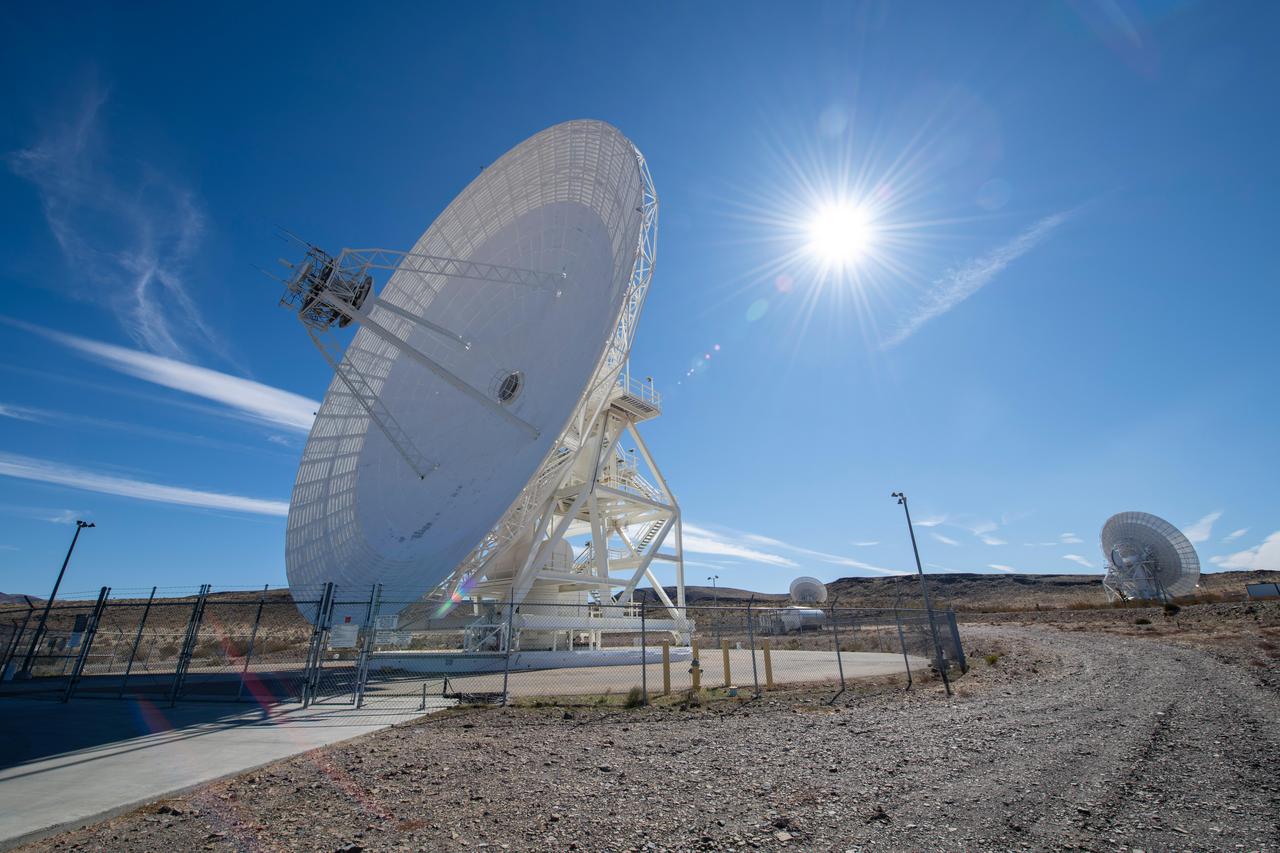
Goldstone's big ears — the same class of dish that listens for probes also listens for neighbors. NASA/JPL