A·01 · The doctrine
The open file
Every so often the instruments say something strange. A probe is thirteen millimeters per second faster than it should be. A star loses a fifth of its light on no schedule at all. A gas is there at midnight and gone by noon. This chapter is the atlas's case file: the anomalies themselves, what it took to chase them down, and — stamped honestly on every one — whether the case is closed, half-closed, or still open on the board.
An anomaly is not a wonder and not a claim. It is a residual — the stubborn difference between what a well-understood instrument measured and what a well-understood theory predicted, after every known effect has been subtracted. Most residuals die quietly: a thermal model improves, a calibration slips into place, a decimal is found. The ones in this file are the survivors — the residuals that outlived years of auditing and, in a few cases, are outliving it still.
The stamps mean what they say. Closed: the cause was found, published, and holds. Partial: the observations are reconciled, but a mechanism underneath is still missing. Open: no accepted explanation. Nothing here is presented as evidence of anything beyond itself — that discipline is exactly what makes the open cases worth keeping.
Status stamps: CLOSED PARTIAL OPEN
A·02 · Case file CLOSED · 1980 – 2012
The Pioneer anomaly
For thirty years, two spacecraft leaving the solar system decelerated by a whisper more than gravity allowed — and the whisper would not go away. It is the best detective story in the deep-space archive, and it was solved by rescued data and thermodynamics.
Pioneer 10 and 11 were nearly perfect test bodies. Spin-stabilized, rarely firing thrusters, they coasted out past Saturn as almost purely ballistic objects — which is why navigators at JPL trusted the tracking enough to notice something intolerable in it. The radio Doppler data carried a tiny, steady blueshift: each craft was slowing toward the Sun by about 8.74 × 10⁻¹⁰ m/s² more than every known force could explain. That is roughly ten billion times weaker than the gravity holding you to your chair, and it showed up in both spacecraft, for decades, from 20 to 70 astronomical units out.
Candidate explanations ran from mundane to heretical: gas leaks, dark matter drag, modified gravity. What killed the mystery was not a new theory but old telemetry. When NASA declined to fund the archaeology, The Planetary Society's members paid to rescue the decaying Pioneer data — decades of magnetic tapes and punch-card-era records — so the full thermal history of each craft could be rebuilt.
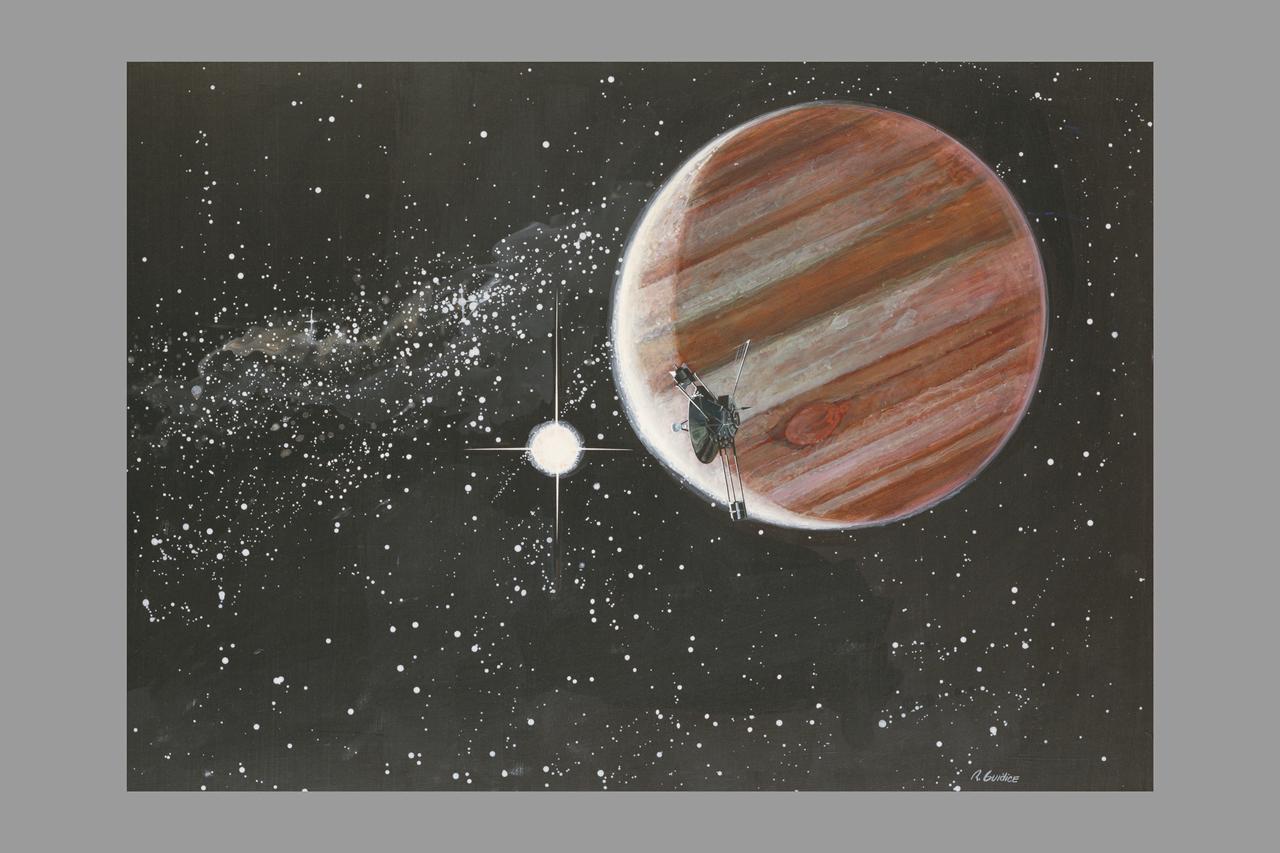
Pioneer at Jupiter — a nearly ideal ballistic object, which is why the residual mattered. NASA/ARC
The closure is the lesson. A residual of ten parts in ten billion was real, it was chased for thirty years, and the answer was heat — photons leaving the warm side of the spacecraft a little more eagerly than the cold side. The file closed in 2012 with nothing exotic inside it, and that is precisely why the still-open cases below deserve respect: this is what it looks like when the process works. The machines that carried the mystery →
A·03 · Case file CLOSED · 2024 ONE THREAD OPEN
The Voyager files
The two oldest working spacecraft keep generating case files — some from dying 1970s hardware, and at least one, maybe, from interstellar space itself.
2022 — the dead computer speaks
Voyager 1's attitude-control system began returning telemetry that was valid-looking garbage — numbers describing no state the spacecraft could physically be in, while the antenna stayed locked on Earth. The trace led somewhere unsettling: the system had started routing its data through an onboard computer known to have died years earlier, which corrupted everything passing through it. Engineers rerouted the telemetry and the readings snapped back. Why the spacecraft switched to a dead computer in the first place was never fully established.
2023–24 — gibberish from 24 billion kilometers
In November 2023 Voyager 1 stopped making sense entirely — a repeating binary pattern instead of science. The fault: a single failed memory chip had corrupted about 3% of the flight data system's memory, taking part of its 1970s code with it. No spare chip exists 24 billion kilometers out, so JPL rewrote the code around the dead region, splitting it across surviving memory — with every command taking 22.5 hours to arrive and every answer 22.5 hours to return. On April 20, 2024, the spacecraft replied in clear. The team's announcement: "Hi, it's me."

Voyager in interstellar space — the only laboratory ever fielded there. NASA/JPL-Caltech
2020 – the pressure front that never relaxed OPEN
Before the memory crisis, Voyager 1 was working a genuine physics case. In 2020 its magnetometer registered an abrupt jump in the interstellar magnetic field while plasma density rose in step. Similar jumps had come and gone before — understood as pressure waves from the Sun slamming into the heliosphere's edge and ringing outward. But this one never relaxed back to baseline, and its persistence has led some of the mission's own scientists to question whether it is solar in origin at all. It remains on the board.
A·04 · Case file PARTIAL
The methane contradiction
One instrument on the ground keeps finding methane on Mars. A far more sensitive instrument overhead keeps finding none. The contradiction has been reconciled — and the reconciliation exposed a deeper problem.
Curiosity's laser spectrometer has detected methane above Gale crater dozens of times since 2012 — a faint seasonal background punctuated by spikes, the largest about 21 parts per billion in 2019. The rover team audited itself mercilessly: pointing, wheel wear, crushed rock, the rover's own exhalations. The measurements held. Meanwhile ESA's Trace Gas Orbiter — built specifically to sniff trace gases, with sensitivity ten to a hundred times better than any prior claim — surveyed the planet and found essentially nothing.
The fix was a question nobody had asked: what if both are right? Curiosity measures at night, when its power-hungry spectrometer can run and the cold air lies still — so methane seeping from the ground pools around the rover. The orbiter needs sunlight and measures by day, when convection has diluted the same gas beyond detection. Both instruments were telling the truth about different hours.
The partial stamp is for what remains: methane on Mars appears and disappears too quickly. Something at or near the surface is scrubbing it by a mechanism no one has identified — and until that ledger balances, the source question stays open too. The full Mars file →
A·05 · Case file PARTIAL
The lunar swirls
Bright, sinuous markings painted across the Moon — visible in a backyard telescope, flat as ink, and sitting precisely on magnetic anomalies of a world with no magnetic field.
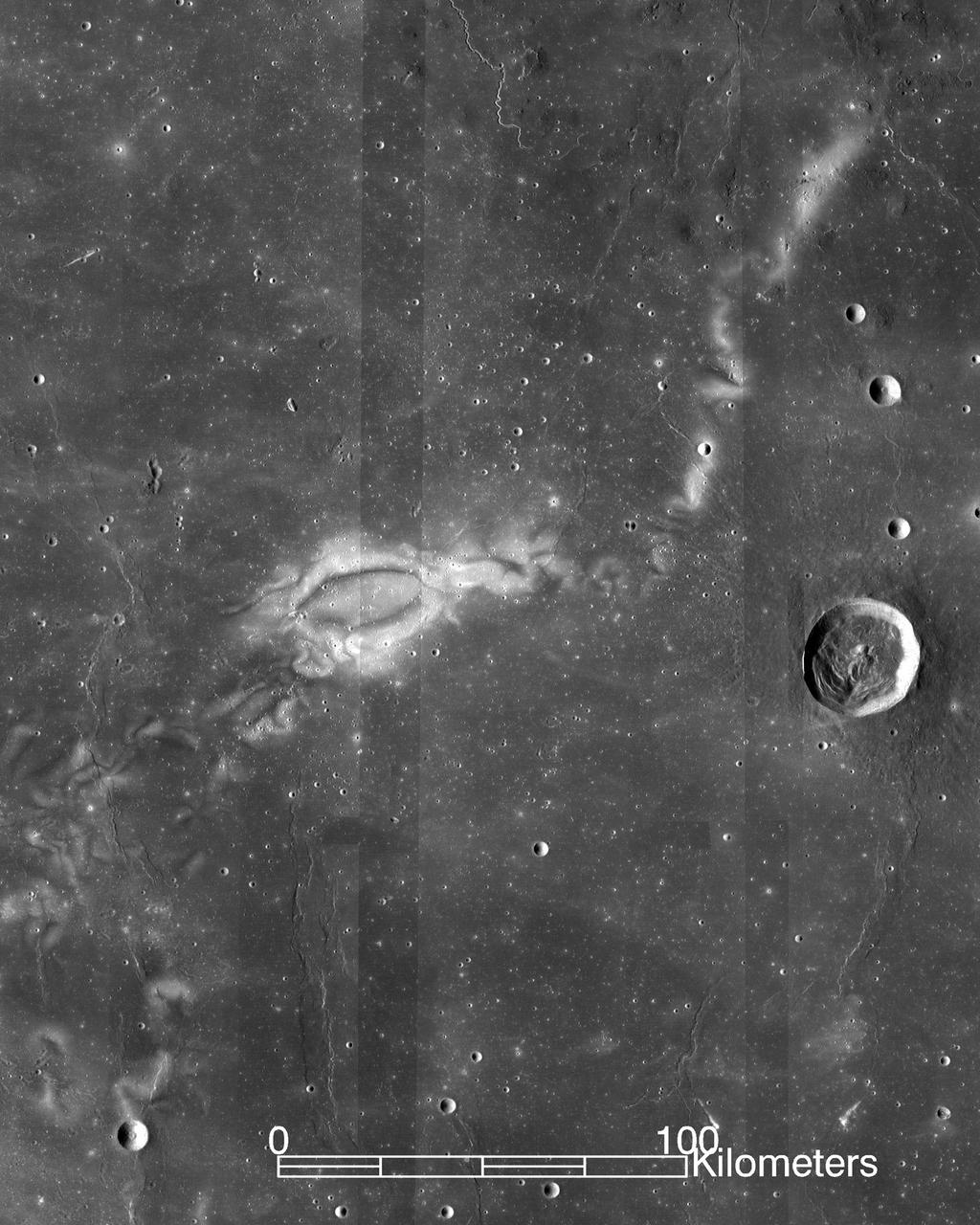
Reiner Gamma in Oceanus Procellarum — no relief, no crater, just pattern. NASA/GSFC/ASU
Reiner Gamma is the type specimen: a tadpole-shaped bright patch with tendrils running hundreds of kilometers, first logged by Renaissance astronomers as a crater — except orbital imagery shows it is purely two-dimensional. No mountain, no rim, no relief. Every known swirl sits on a patch of magnetized crust; the Moon has no global field, only this crazy-quilt of local ones, and Reiner Gamma's is among the strongest.
The working model is elegant: the magnetic pockets act as sunscreen. Solar wind slowly darkens lunar soil; where a mini-magnetosphere deflects it, the surface keeps its youth — tan lines on a world. Supercomputer plasma simulations now reproduce swirl-like patterns from this standoff. But the model is half a story: not every magnetic anomaly has a swirl, and nobody has settled where the magnetism itself came from — ancient magnetized lava underground, or the plasma of comet impacts. A dedicated lander-rover mission to Reiner Gamma is the designed tiebreaker.
A·06 · Case file OPEN · 1990 –
The flyby anomaly
The Pioneer anomaly's stranger sibling — and the one that never got solved. Spacecraft slingshotting past Earth have repeatedly come out with more energy than the books allow.
It started with Galileo in December 1990: after its Earth gravity assist, Doppler tracking showed a velocity a few millimeters per second off the prediction. Then NEAR in 1998 — 13 mm/s fast, against a measurement precision of 0.1 mm/s. That is not a rounding error; it is a hundred-and-thirty-sigma discrepancy in a maneuver celestial mechanics is supposed to own outright. A 2008 analysis of six flybys — Galileo, NEAR, Cassini, Rosetta, MESSENGER — found anomalous energy changes of order one part in a million and, in the authors' words, no physical cause and no systematic error to blame.
The one clean clue is geometric: the effect is largest for flybys most asymmetric about Earth's equator, and MESSENGER — whose trajectory was nearly symmetric — showed almost none. That pattern points at something tied to Earth's rotation, but two decades of candidates (frame-dragging, atmospheric drag, tidal effects, dark matter halos) have each failed quantitatively. Later flybys muddied rather than settled it, and the case simply went quiet without closing. It sits in the file as the solar system's politest unsolved discrepancy: small, repeatable, and unexplained.
A·07 · Case file OPEN · 2015 –
Boyajian's star
Found not by an algorithm but by volunteers reading Kepler's archive by eye: an ordinary F-type star, 1,470 light-years out, that dims by up to 22% on no schedule known to astrophysics.
Kepler stared at KIC 8462852 for four years, and citizen scientists in the Planet Hunters project flagged what the transit pipelines had skipped: dips of half a percent to 22%, lasting days to weeks, asymmetric, aperiodic, unrepeating. A planet subtracts a clean fraction of light on a clock. This looked like smoke drifting across a searchlight. The star itself is boringly normal — no youth, no infrared excess, no companion close enough to matter — which is what made the light curve scandalous, and briefly made "alien megastructures" a hypothesis in the refereed literature.
The deeper archive made it stranger: photographic plates suggest a ~16% fade across the twentieth century, and Kepler's own full-frame images confirm a 3% decline in just four years. Whatever does this operates on timescales from days to decades.
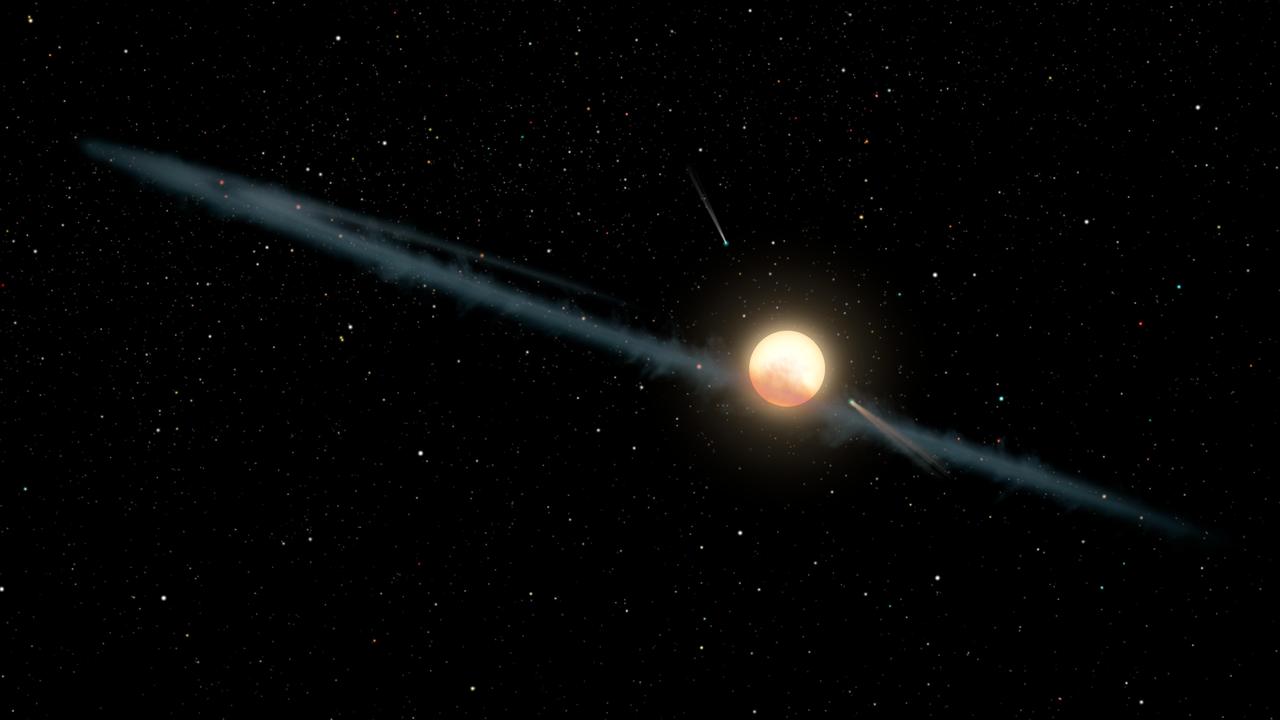
The leading suspect: uneven, fine dust — illustrated, because nobody has seen it. NASA/JPL-Caltech
The megastructure died honorably: when the dimming resumed in 2017, it was deeper in blue light than red — the signature of fine dust, not solid engineering. But dust is a description, not an explanation. The grains implied are so small the star's own radiation should blow them away in days, so something must replenish them continuously — shredded comets, a consumed planet, an unlucky interstellar cloud. Every candidate explains part of the record; none explains all of it. How ordinary stars behave →
A·08 · Case file OPEN · 2022 –
The little red dots
Weeks into JWST's science mission, tiny crimson points began appearing in every deep image — a few percent of all known galaxies in the universe's first billion years, and four years on, nobody has settled what they are.
They are compact beyond comfort, red in the rest frame, with odd V-shaped spectra and hydrogen gas moving at velocities that suggest something massive and violent in a very small volume. The two obvious readings were both extraordinary: either impossibly dense galaxies — some implying that nearly every available atom had been converted to stars, which standard structure formation cannot do — or overgrown black holes in galaxies far too small to have raised them, oddly silent in X-rays where feeding black holes should shout.
The newest candidate splits the difference with something genuinely new: "black hole stars" — a black hole swallowing matter inside a vast, cool cocoon of hydrogen that glows like the atmosphere of a single colossal star. If that holds, the little red dots are not weird galaxies at all but the first sighting of an object class no survey predicted — possibly the missing step in how the first supermassive black holes grew. The population is real, abundant, and confined to the early universe; its nature is the freshest open case in the file. The rest of cosmology's open problems →
A·09 · Case file OPEN · 2006 –
The space roar
A balloon went up to listen for the first stars and came back with a radio hiss six times louder than everything in the sky put together — a roar with no source anyone can name, loud enough to drown out the very signal it was sent to find.
ARCADE — the Absolute Radiometer for Cosmology, Astrophysics, and Diffuse Emission — was built to be brutally honest about brightness. Most radio telescopes measure one patch of sky against another; ARCADE measured absolute temperature, its seven radiometers chilled to 2.7 degrees above absolute zero in 500 gallons of liquid helium and flown to 37 kilometers on a balloon out of Texas in July 2006. Its quarry was faint: the warmth of the very first stars, hidden under the microwave sky.
What it found instead was a wall of noise. After subtracting the cosmic microwave background and the Milky Way's own glow, a diffuse radio hiss remained — an isotropic synchrotron background running about five to six times brighter than the sum of every known radio galaxy in the universe. It comes from all directions equally, so it is not one object; it has the spectral "color" of synchrotron radiation, so it is charged particles spiraling in magnetic fields somewhere — but a background that smooth, that bright, matches no population of sources anyone can point to.
The open stamp comes with a caveat this file insists on: the roar's very existence is contested. Rebuild the Milky Way's synchrotron emission with more than one component and part of the excess can evaporate — so the case may yet close not with a discovery but with a better foreground model. Either way it stands as a warning about absolute measurements: the universe gave ARCADE something it wasn't looking for, and four years of the instruments that see → still can't say what.
A·10 · Case file PARTIAL
ʻOumuamua's kick
The first known visitor from another star left our solar system faster than gravity alone allowed — and showed none of the outgassing that explains the same trick in every comet we know. The leading answer is elegant, quantitative, and still argued over.
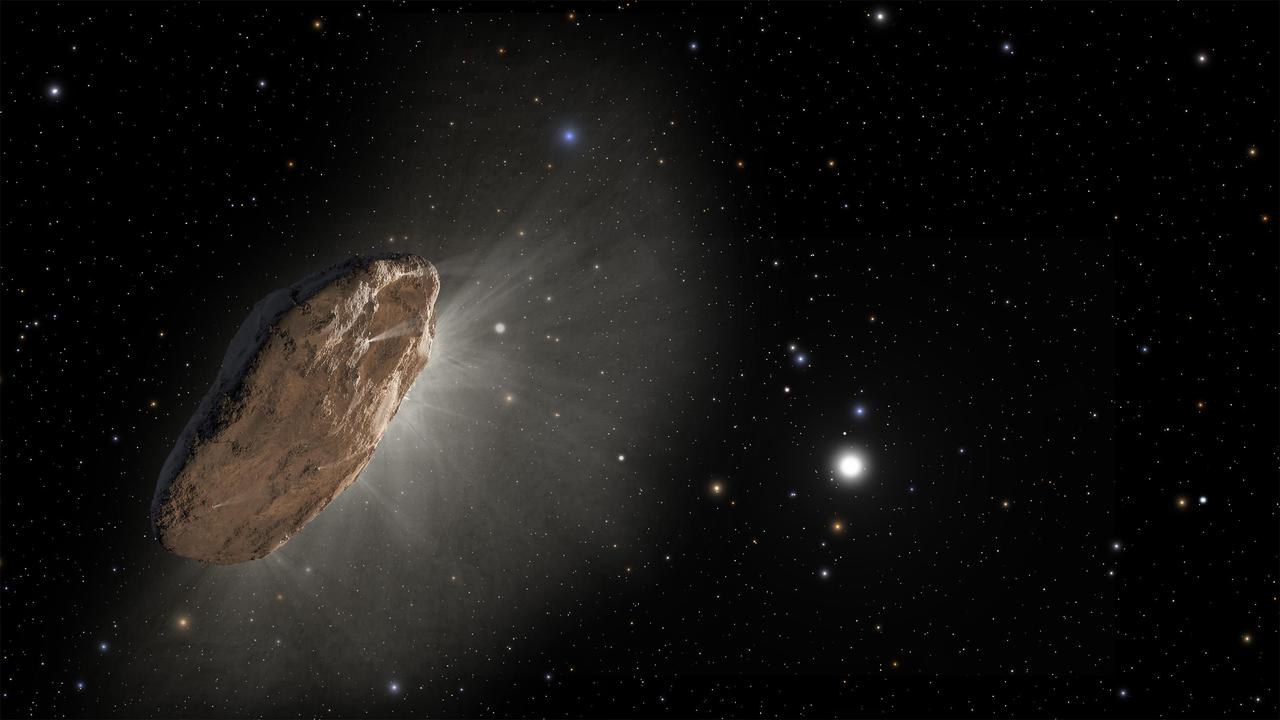
ʻOumuamua — cigar or pancake, nobody is sure; the first interstellar object logged. NASA/JPL-Caltech (illustration)
In 2017, 1I/ʻOumuamua fell through the inner solar system on a hyperbolic track that could only have come from interstellar space. Two and a half months of astrometry revealed, at 30-sigma significance, a small push away from the Sun that gravity could not account for — falling off with distance like sunlight, in the direction outgassing recoil would point. In any ordinary comet that is a solved phenomenon: warmed ices jet away and shove the nucleus like a thruster. But ʻOumuamua showed no coma, no dust tail, no gas — and the sunlight it caught was too weak to sublimate enough water to do the job.
The 2023 resolution is clever: interstellar cosmic rays, over millions of years, convert the outer meters of water ice into trapped molecular hydrogen. Warmed by the Sun, that hydrogen escapes from a thin shell — a gas so light and diffuse it leaves no visible coma, yet on an object this small supplies exactly the push observed. No new physics; no aliens; a mechanism that may quietly operate in comets everywhere.
The partial stamp is earned honestly. The hydrogen-outgassing model reproduces the number, and it retired the "alien lightsail" reading that briefly reached the refereed literature — the radiation- pressure case required an implausibly thin, sail-like body. But real objections remain on the board: the recoil should have torqued so small an object into spinning itself apart, and at least one analysis argues the acceleration fit is fragile. The verdict is probably a natural comet of a kind we'd never caught before — and the Rubin Observatory should now find one to three interstellar objects a year to test it. The comets and asteroids next door →
A·11 · Case file PARTIAL
The Wow! signal
For 47 years, the most famous radio signal in SETI's history had no accepted natural source — a 72-second blast at the hydrogen frequency, so striking the astronomer who found it wrote one word beside it on the printout. Archival data may finally have named it.
On August 15, 1977, Ohio State's Big Ear telescope — running the longest SETI survey in history — recorded a narrowband signal near 1420 MHz, the neutral-hydrogen line long argued to be the natural channel any civilization would choose. It rose and fell over 72 seconds exactly as a fixed point in the sky drifting through the beam should, from the direction of Sagittarius. Jerry Ehman circled the printout and wrote "Wow!" It never repeated, through decades of follow-up on ever larger dishes.
The break came from space archaeology. The Arecibo Wow! project, digitizing archived Ohio SETI and Arecibo drift scans, found in 2020 data several signals with the Wow!'s narrowband, hydrogen-line character — two orders of magnitude fainter, and each aligned with a cold interstellar hydrogen cloud. Their proposed mechanism: a sudden brightening of one such cloud, stimulated into radio incandescence by a passing burst from a magnetar or soft gamma repeater behind it — a natural maser flare, briefly turning a quiet cloud into a beacon at exactly the frequency SETI listens on.
The partial stamp reflects the team's own restraint — their words are that the work gives the clearest picture yet of the signal, not that it solves it. What earns this case its place is the method: a signal from 1977, on hardware long since dismantled, being cornered by re-examining rescued tape with instruments that didn't exist when it was recorded — the same craft that closed the Pioneer file →. And it made a terrestrial or technological origin markedly less likely, which is its own kind of progress. The wider search it belongs to →
A·12 · The docket
Status board
Every case on file, its residual, and what closed it — or what it would take.
| Case | The residual | Status | Resolution / what would close it |
|---|---|---|---|
| Pioneer anomaly | ~10⁻⁹ m/s² sunward deceleration, both craft, 30 years | CLOSED | Anisotropic waste heat (2012), via crowdfunded data rescue |
| Voyager 1 telemetry, 2022 | Valid-looking garbage routed through a dead computer | CLOSED | Rerouted; root cause of the switch never established |
| Voyager 1 memory, 2023–24 | Pure gibberish from interstellar space | CLOSED | One dead chip; code rewritten around it across 24 bn km |
| Mars methane | Detected nightly at the surface, absent from orbit | PARTIAL | Diurnal cycle reconciles the data; destruction mechanism unknown |
| Lunar swirls | Bright 2-D patterns locked to crustal magnetism | PARTIAL | Solar-wind sunscreen works; origin of the magnetism unsettled — a Reiner Gamma surface mission is the tiebreaker |
| Earth flyby anomaly | Up to +13 mm/s of unbudgeted energy at gravity assists | OPEN | A dedicated flyby with modern tracking, designed for the question |
| Boyajian's Star | Aperiodic dimming to 22%; a century-long fade | OPEN | Catching a deep dip with spectroscopy in the act |
| Little red dots | An abundant object class confined to the first billion years | OPEN | Deeper spectra; X-ray stacking; a model that survives the dust budget |
| Voyager 1 pressure front | A 2020 field-and-density jump that never relaxed | OPEN | Time — and whatever Voyager 2 meets on its own track |
| Space roar | A radio background ~6× brighter than all known sources | OPEN | A better Galactic-foreground model may erase it — or a new source population may explain it |
| ʻOumuamua's kick | A sunward push with no visible outgassing | PARTIAL | Radiolytic-hydrogen outgassing fits the number; the spin-up objection stands. Rubin will find more |
| Wow! signal | A one-off 72-s blast at the hydrogen line, 1977 | PARTIAL | Archival analogs suggest a maser flare off a cold H I cloud; the trigger was never caught |
The closed rows are why the open rows are trustworthy. This field's habit — audited by the Pioneer file above — is to spend decades trying to kill its own mysteries, and to stamp them honestly when it fails. The theoretical open problems → keep the company of these instrumental ones.