R·01 · The gatekeeper
The tyranny of the rocket equation
Everything else in this atlas — every probe, telescope, and bootprint — first had to get past one line of mathematics. Konstantin Tsiolkovsky wrote it down in 1903, before airplanes could cross a county: how much speed a rocket gains depends on its exhaust velocity and the logarithm of its fuel-to-ship ratio. That logarithm is the villain. Drag the sliders and watch it work.
Low Earth orbit demands roughly 9.4 km/s once gravity and drag take their cut. With the best chemical propellants, the equation forces a brutal answer: the vehicle must be about 85–94% propellant. The ship itself — tanks, engines, payload, people — gets the leftovers. That is why rockets are giant thin-walled fuel tanks, why payloads are typically only 2–5% of liftoff mass, and why every kilogram sent to orbit is argued over. The equation cannot be repealed; it can only be out-engineered.
Two escape routes exist. Staging — the first out-engineering trick — throws away empty tankage mid-flight so the equation restarts with a smaller, lighter ship; that's why nearly every orbital rocket in history is a stack of rockets riding rockets. Higher exhaust velocity is the other: hydrogen engines beat kerosene, and in space, ion drives beat everything — pushing gently for years with exhaust ten times faster than any chemical flame. Dawn and Hayabusa cruised the asteroid belt that way.
R·02 · The heavy lifters
Machines that shake the ground
A large rocket at full thrust is the most powerful machine humans operate — a controlled, continuous explosion pointed at the floor.
The benchmark for half a century was the Saturn V: 2,970 tonnes at liftoff, 111 meters tall, about 140 tonnes to low orbit — and its five F-1 engines drank propellant by the swimming pool. It flew thirteen times, never lost a crew, and put every set of human footprints on the Moon →. The Space Shuttle that followed traded raw lift for reuse-in-theory: a spaceplane that came home, strapped to throwaway tanks and boosters, that taught the industry — at terrible cost, twice — how hard "routine" spaceflight really is.
Today's giants split the philosophy. NASA's SLS is a Saturn-class expendable built for Artemis lunar missions; it flew the uncrewed Artemis I loop around the Moon in 2022. SpaceX's Starship is the opposite bet: the largest rocket ever flown, designed so that both stages come back — its booster was first caught out of the air by the launch tower's arms in October 2024, a maneuver that looked like science fiction on the way to becoming procedure.
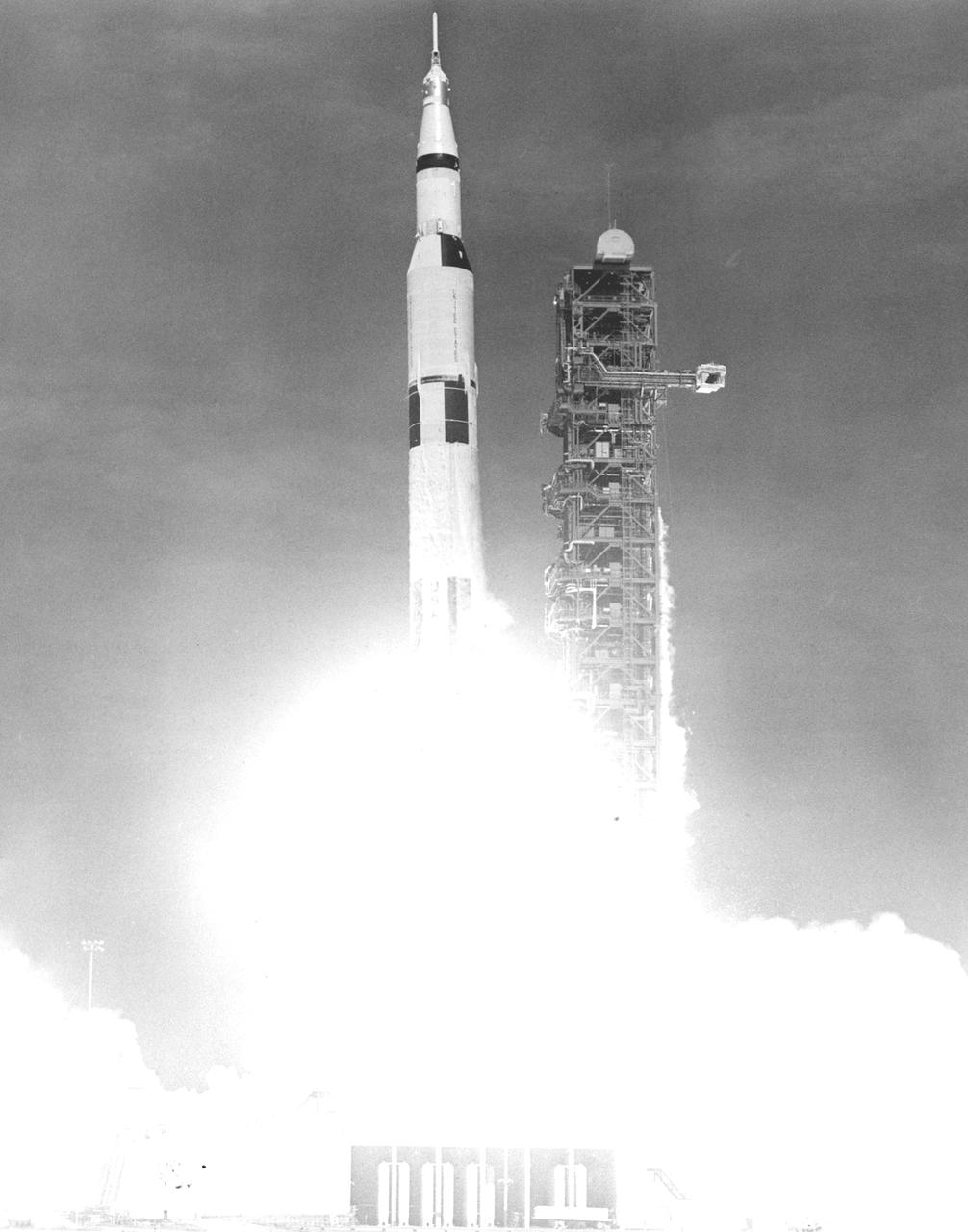
Saturn V — still the yardstick. NASA
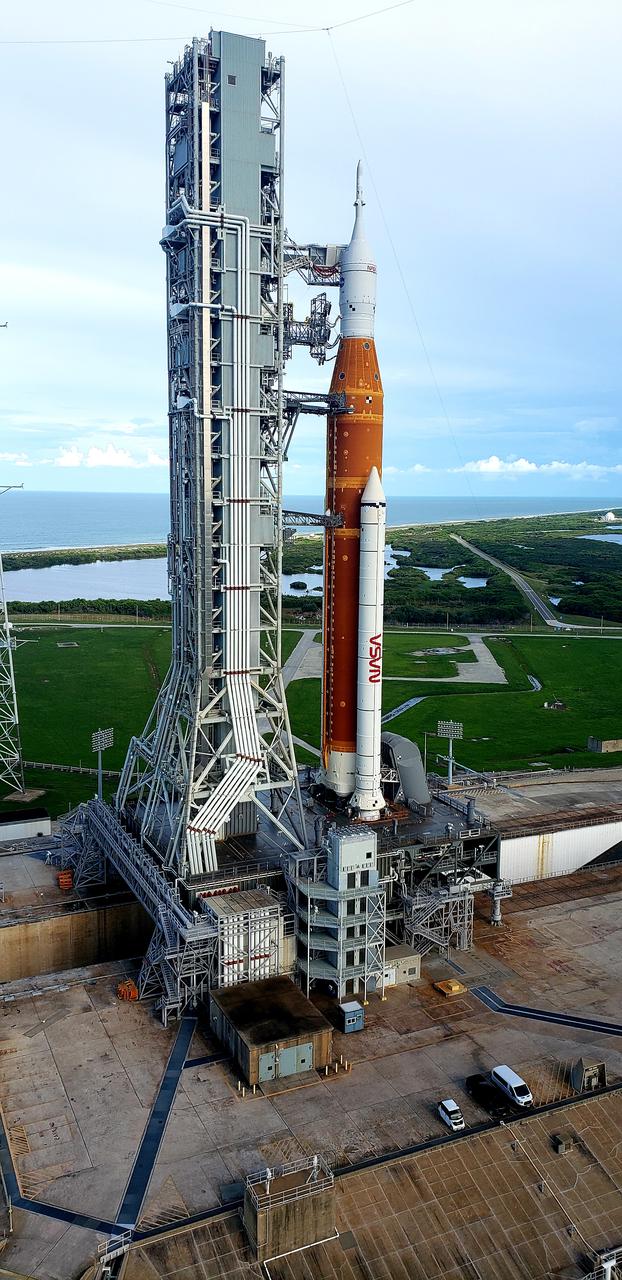
SLS on pad 39B — the same pad Saturn V used. NASA/KSC
R·03 · The revolution
Rockets that come back
For sixty years, orbital rockets were used once — like flying a 747 to Paris and scrapping it on the runway. On December 21, 2015, a Falcon 9 first stage flew to the edge of space, turned around, and landed standing up. The economics of the entire field pivoted that night.
Reuse attacks the only part of the price that engineering can reach: the hardware. Propellant is a rounding error — the metal was the money. Falcon 9 boosters now routinely fly, land on ships or pads, and fly again — individual boosters have logged twenty-plus missions — and launch cadence rose from a national event to a weekly errand. The consequences ripple through this whole site: cheap lift is what makes mega-constellations, bigger space telescopes →, and serious Mars architectures → arguable at all. Starship's wager is that full reuse of everything drops the cost another order of magnitude. If it pays out, the bottleneck of the entire space age quietly disappears.
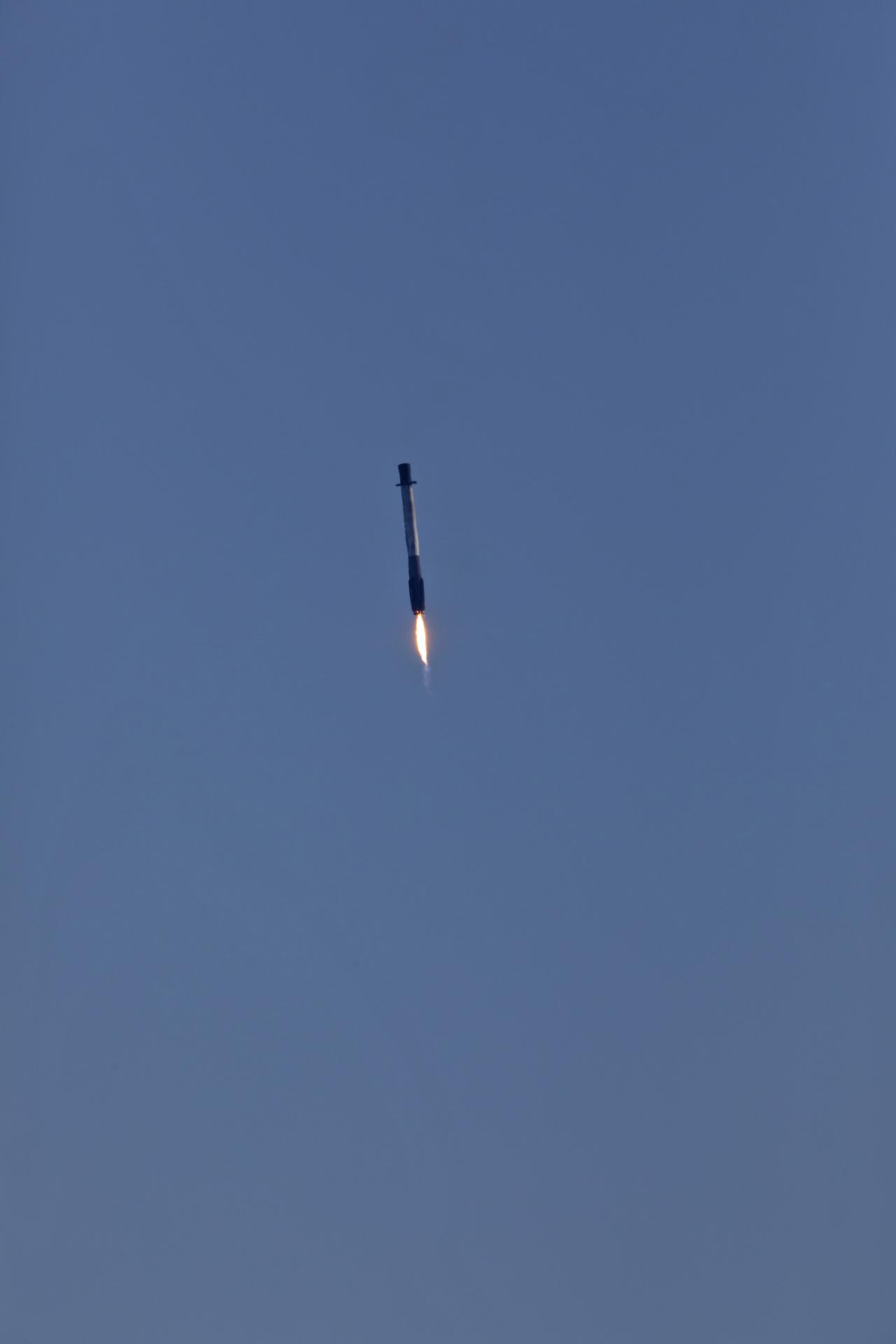
Falcon 9 — the booster on this flight was already a veteran. NASA/KSC
Discovery — reuse, version one. NASA/HQ
R·04 · The manifest
Ways off the planet, today
A field guide to the current generation — what lifts, and what it's for.
| Vehicle | Operator | Class | The role |
|---|---|---|---|
| Falcon 9 / Heavy | SpaceX (US) | Medium–heavy, reusable booster | The workhorse — crews, cargo, constellations, most of the world's launches |
| Starship / Super Heavy | SpaceX (US) | Super-heavy, fully reusable (in test) | The bet — Artemis lunar lander contract, Mars ambitions |
| SLS | NASA (US) | Super-heavy, expendable | Artemis crewed lunar missions |
| New Glenn | Blue Origin (US) | Heavy, reusable booster | The second reusable heavy — first flight January 2025 |
| Ariane 6 | ESA / Arianespace | Medium–heavy, expendable | Europe's ride — institutional and commercial payloads |
| Long March family | CNSA / CASC (China) | Light to heavy | China's full program: station, lunar sample returns, planetary missions |
| H3 | JAXA (Japan) | Medium | Japan's new mainstay |
| Electron | Rocket Lab (US/NZ) | Small | The dedicated small-sat taxi |
| Soyuz | Roscosmos (Russia) | Medium | The longest-serving design in spaceflight — flying since 1966 |
Every machine on the missions page → rode one of these families or their ancestors. The atlas's quiet rule: no rocket, no astronomy from space.