B·01 · The leftovers
Small worlds, original parts
Planets melt, churn, and erase their own history. The small bodies never did — the asteroids and comets are the solar system's unopened packaging, 4.6-billion-year-old parts that never got assembled into anything bigger. Which is why, pound for pound, no destinations have taught us more about where everything came from.
Start by unlearning the movie version: the asteroid belt between Mars and Jupiter is mostly emptiness — its entire mass is a few percent of the Moon's, and spacecraft cross it without steering. It exists because Jupiter's gravity never let a planet accrete there. Further out, beyond Neptune, the Kuiper Belt holds the frozen versions — and all the way out, the theorized Oort cloud shell that the edge section maps → sends us long-period comets like messages from the property line.
B·02 · The belt's giants
Ceres & Vesta — one probe, two worlds
The Dawn spacecraft did something no mission had done: it orbited one alien world, fired up its ion engines, left, and orbited another.
Vesta (2011–2012) turned out to be a surviving protoplanet — a differentiated body with an iron core and a mountain at its south pole rising higher than Everest, gouged by an impact that scattered fragments across the inner solar system; about one in twenty meteorites on Earth is a piece of Vesta. Ceres (2015–2018), the belt's dwarf planet at 940 km across, saved the twist: brilliant white deposits shining from Occator crater — sodium carbonate, salt left behind by brines that seeped up from a briny layer below. An asteroid-belt body with residual ocean-world plumbing →. The line between "asteroid" and "world" got blurry fast.

Occator's bright spots — salt from a buried brine. NASA/JPL/Dawn
B·03 · The visitors
Comets — ice that grows a tail
A comet is a few kilometers of primordial ice and dust that, falling sunward, boils into a temporary atmosphere bigger than planets and a tail millions of kilometers long. Watch the geometry below: the tails don't trail behind — they point away from the Sun, whichever way the comet is moving.
Two tails, two physics: the blue ion tail is gas snapped straight anti-sunward by the solar wind; the pale dust tail lags into a curve along the orbit. Halley's 1986 visit met a fleet of probes; it returns in 2061. The masterpiece was ESA's Rosetta, which spent 2014–2016 living with comet 67P — orbiting a rubber-duck-shaped nucleus, dropping the Philae lander (which bounced twice into a shaded ditch and still delivered), watching the comet wake up as it neared the Sun, and finally touching down on it to end the mission. Comet water, it found, isn't quite Earth's water — a real constraint on the old idea that comets filled our oceans.
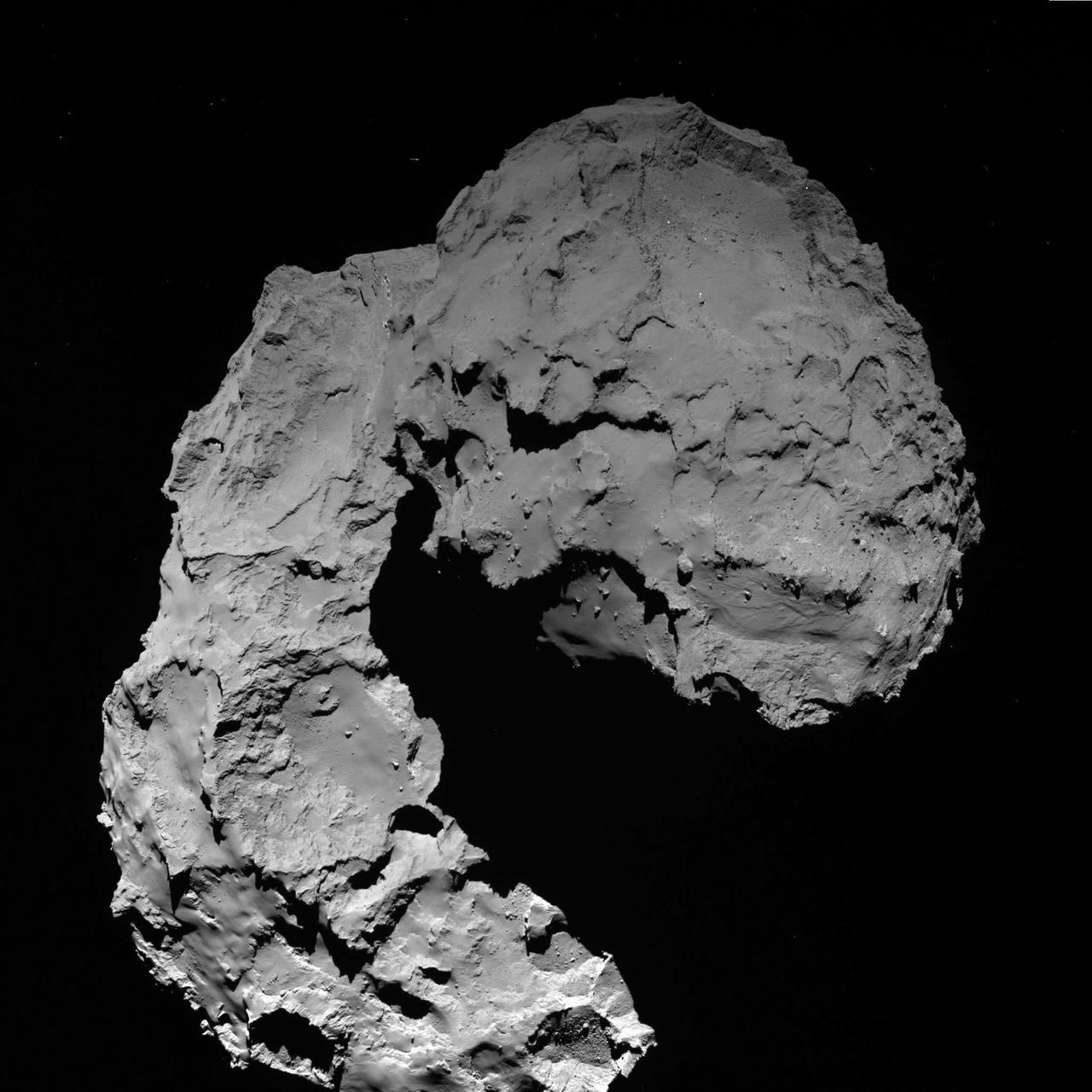
67P by Rosetta — two ancient lobes, gently fused. ESA/Rosetta
B·04 · Bringing pieces home
The sample couriers
Telescopes read light; laboratories read atoms. Three missions closed the loop by grabbing pieces of small worlds and mailing them to Earth.
Japan went first: Hayabusa limped home in 2010 with grains of asteroid Itokawa — the first asteroid sample ever — and Hayabusa2 upgraded the trick at Ryugu, firing a copper slug into the surface to excavate fresh material, returning it in 2020 with amino acids aboard. NASA's OSIRIS-REx nearly sank into asteroid Bennu — the surface behaved like a ball pit, not rock — and its capsule parachuted into Utah on September 24, 2023 carrying about 120 grams. Bennu's grains hold water-altered minerals and a rich organic inventory: the delivery-service hypothesis — that bodies like these seeded young Earth with water and prebiotic chemistry — now has physical exhibits. The spacecraft itself, renamed OSIRIS-APEX, flew on — its next stop appears in the final section.
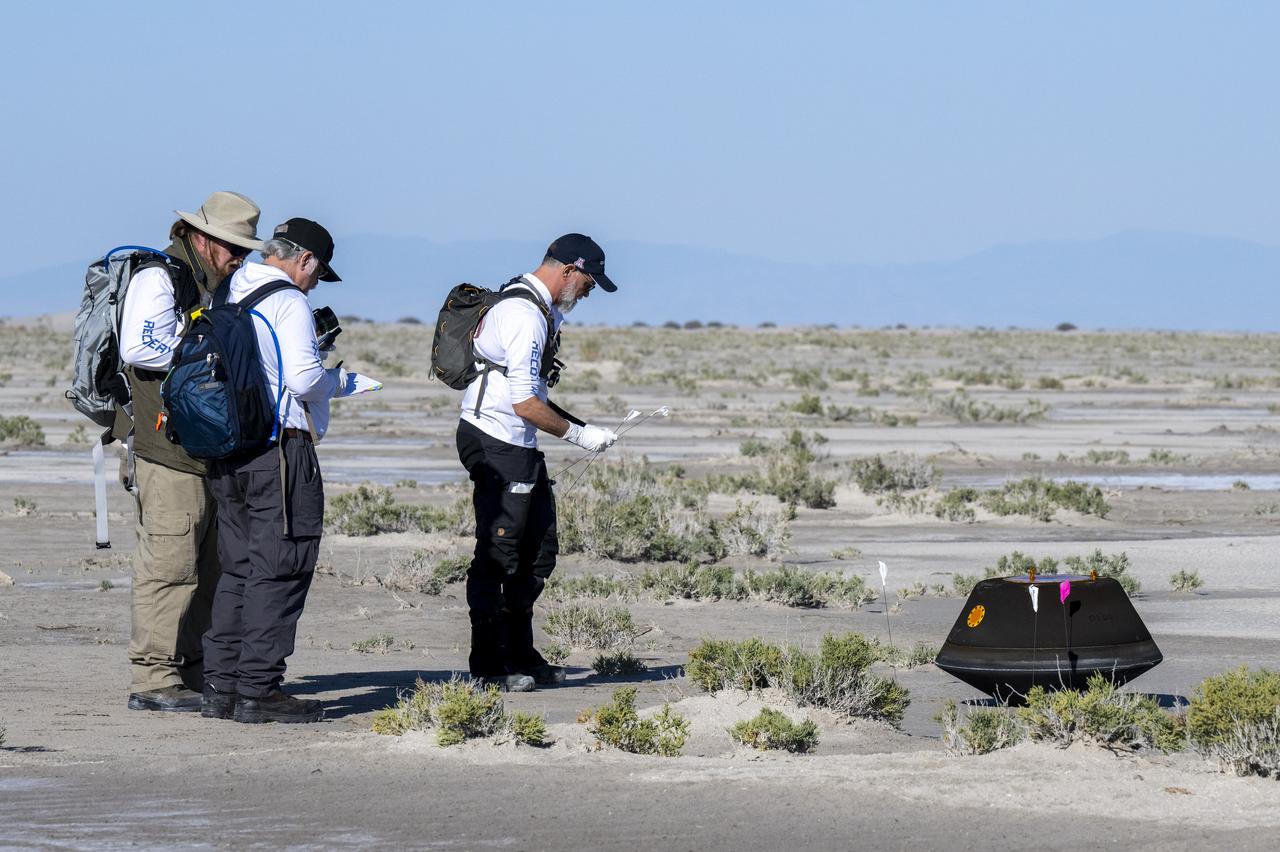
The Bennu capsule, minutes after touchdown — 4.6-billion-year-old cargo. NASA
B·05 · The far kingdom
Pluto & the Kuiper Belt
When New Horizons launched in 2006, Pluto was a planet and a point of light. When it arrived on July 14, 2015, after nine and a half years and five billion kilometers, Pluto had been reclassified — and then it upstaged the whole argument by being magnificent.
The flyby revealed a working world: a thousand-kilometer nitrogen-ice glacier — Sputnik Planitia, the bright half of the famous heart — visibly churning with convection cells and utterly craterless, meaning it resurfaces itself today. Water-ice mountains the size of the Rockies float in it like icebergs. A blue haze layers the sky; the big moon Charon wears a dark red polar cap made of material escaped from Pluto. And the heart's gravity signature hints at a buried ocean — the census's most distant maybe-member →.
New Horizons kept going. On New Year's Day 2019 it flew past Arrokoth, a small two-lobed Kuiper Belt object that looks like a snowman gently pressed together — the most primitive world ever visited, two bodies that merged at walking speed and then changed almost nothing for four and a half billion years. The Kuiper Belt holds thousands of such fossils, plus Pluto's fellow dwarf planets — Eris, Makemake, Haumea — none yet visited. The far kingdom is barely opened.

Pluto's heart — the left lobe is a living nitrogen glacier. NASA/JHUAPL/SwRI
B·06 · The one with our name on it
Apophis, and the art of not being hit
On Friday, April 13, 2029, a 340-meter asteroid named Apophis will pass closer to Earth than the satellites broadcasting your television — visible to the naked eye as a slow star crossing the evening sky over Europe, Africa, and western Asia. It will miss. We checked. That we could check is the point of this section.
When Apophis was discovered in 2004, early arithmetic gave it a small but real chance of impact in 2029 — the highest ever recorded at the time — and the god-of-chaos name stuck. Years of radar ranging shrank the uncertainty until, in 2021, the verdict became clean: no impact risk from the 2029 pass, and none for at least a century. The flyby is now a gift instead of a threat: Earth's gravity will measurably knead the asteroid as it passes, and OSIRIS-APEX — the Bennu spacecraft, redirected — arrives right after closest approach to watch a small world get tidally rearranged in real time.
And if the arithmetic had gone the other way? In 2022 the DART spacecraft rammed the small moonlet Dimorphos at 6 km/s and shortened its orbit by about half an hour — several times the prediction, thanks to the recoil of ejected debris. Humanity's first planetary-defense test didn't just work; it overperformed. Combined with the survey telescopes cataloguing near-Earth objects — the watch, described here → — the dinosaurs' problem is becoming an engineering problem. Small worlds began this page as the origin story; they end it as the one natural disaster with an off switch.
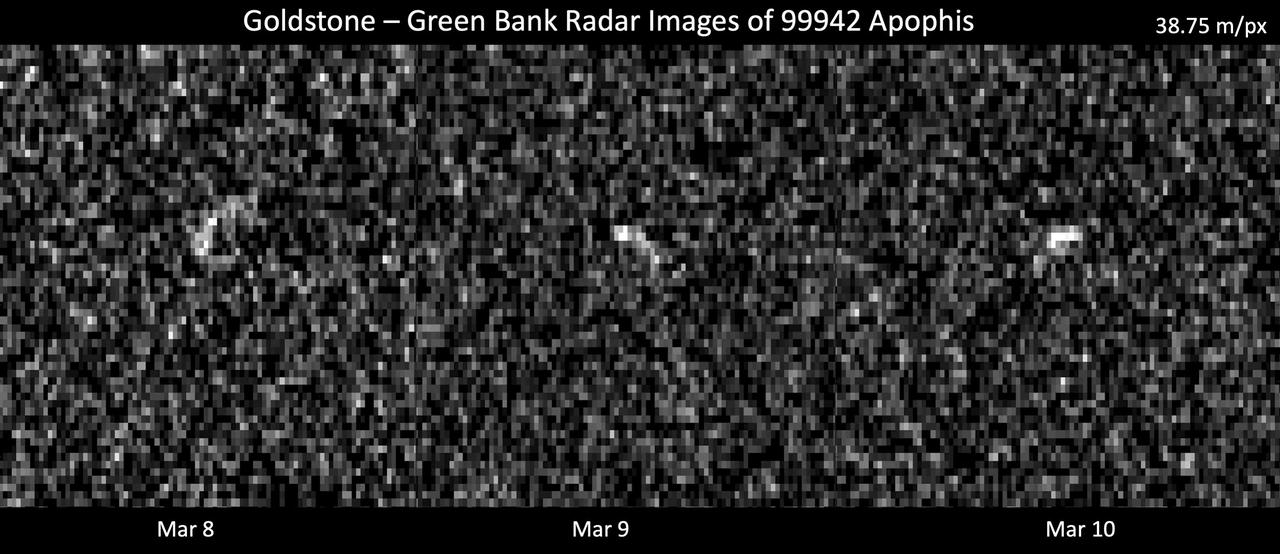
Apophis in radar — the ranging campaign that retired the risk. NASA/JPL-Caltech